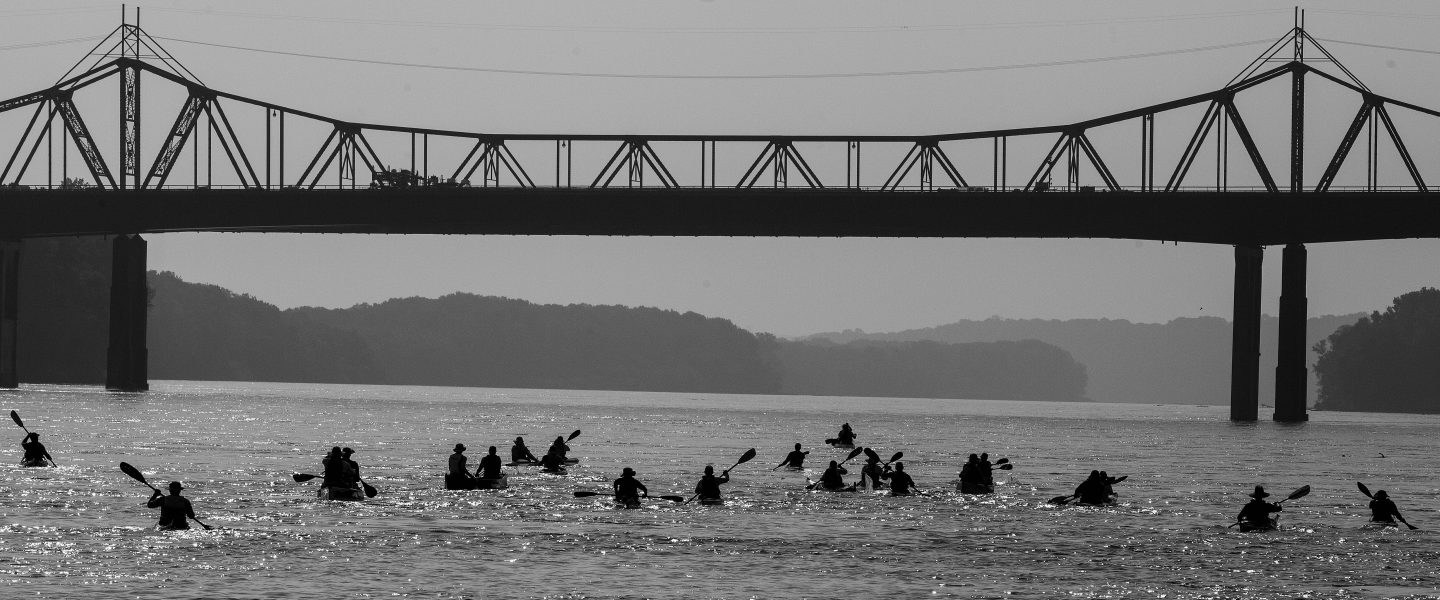
Trak Kayaks Expedition: San Juan Islands Trip Report

August 23 – 29, 2026

Quick and Dirty Recap: 

Day 1: Anacortes, WA – Sunset Beach to James Island

Day 2: James Island to Spencer Spit to Blind Island (Shaw Island)

Day 3: Shaw Island Circumnavigation

Day 4: Blind Island to Jones Island

Day 5: Jones Island to Turn Island

Day 6: Turn Island to Turn Point County Park

Day 7: (Personal solo paddle day: Sunset Beach around Burrows Island to Cabana Park)
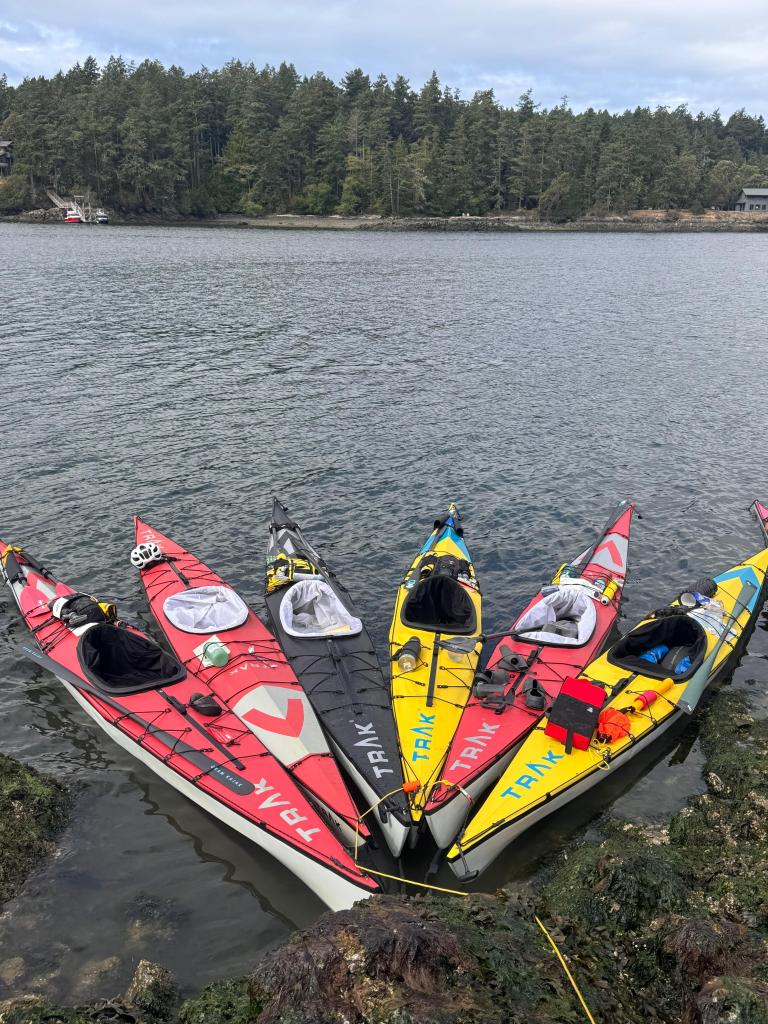
A couple years ago, I saw a social media post about Trak Kayaks, a collapsible yet legit sea kayak, and they were looking for ambassadors for their boats. Basically, the deal was to acquire one of their boats at a discounted price, then act as sort of a regional source for anyone interested in their boats to meet up, try out the boat and potentially purchase it if they like it. I talked on the phone with a couple of good people at Trak, told them about our vibrant midwestern paddling community then dove in as an ambassador – a Trak Pilot. 

Fast forward a bit and I’ve paddled this really nice boat on our local rivers, even racing in a very rocky Bourbeuse Bluebell Race, scraping rocks along the way. I was impressed how well a sea kayak with a skin held up to a proper Ozark stream. But what I had not yet done is what the real selling point of these boats is – to pack it up into its checked bag-sized roller duffel, fly across the country or the world with it and paddle on a proper ocean, which is really what these boats are made for. Trak organizes meetups and trips all over the world, from the Pacific Northwest to Baja, Central America, Patagonia, Europe, Asia and tons of other places. 

So this summer, as a vacation from full time river guiding with Big Muddy, I naturally chose to take a week away to paddle. Caleb at Trak highly recommended I check out the trip to the San Juan Islands, just off the coast of Washington state just north of Seattle. Caleb raved about Alex Lalonde, the primary guide for the trip, as well as the opportunity to learn the ins and outs of coastal kayaking in a beautiful but relatively calmer environment than the open sea. I signed up and booked the flights. 

The trip was a 6 day, 5 night expedition, with a group paddling Trak kayaks from island to island within the San Juans, camping on islands every night, pretty much a self-supported trip. I have fortunately had the opportunity to undertake this format of paddling down the Missouri and Mississippi Rivers, but never on salt water – not quite the open sea but ocean paddling nonetheless. I was very excited to learn much more about things that the oceans have that the big rivers don’t – tides, currents, fetch, surf and tons of little nuances you get with ocean paddling. 

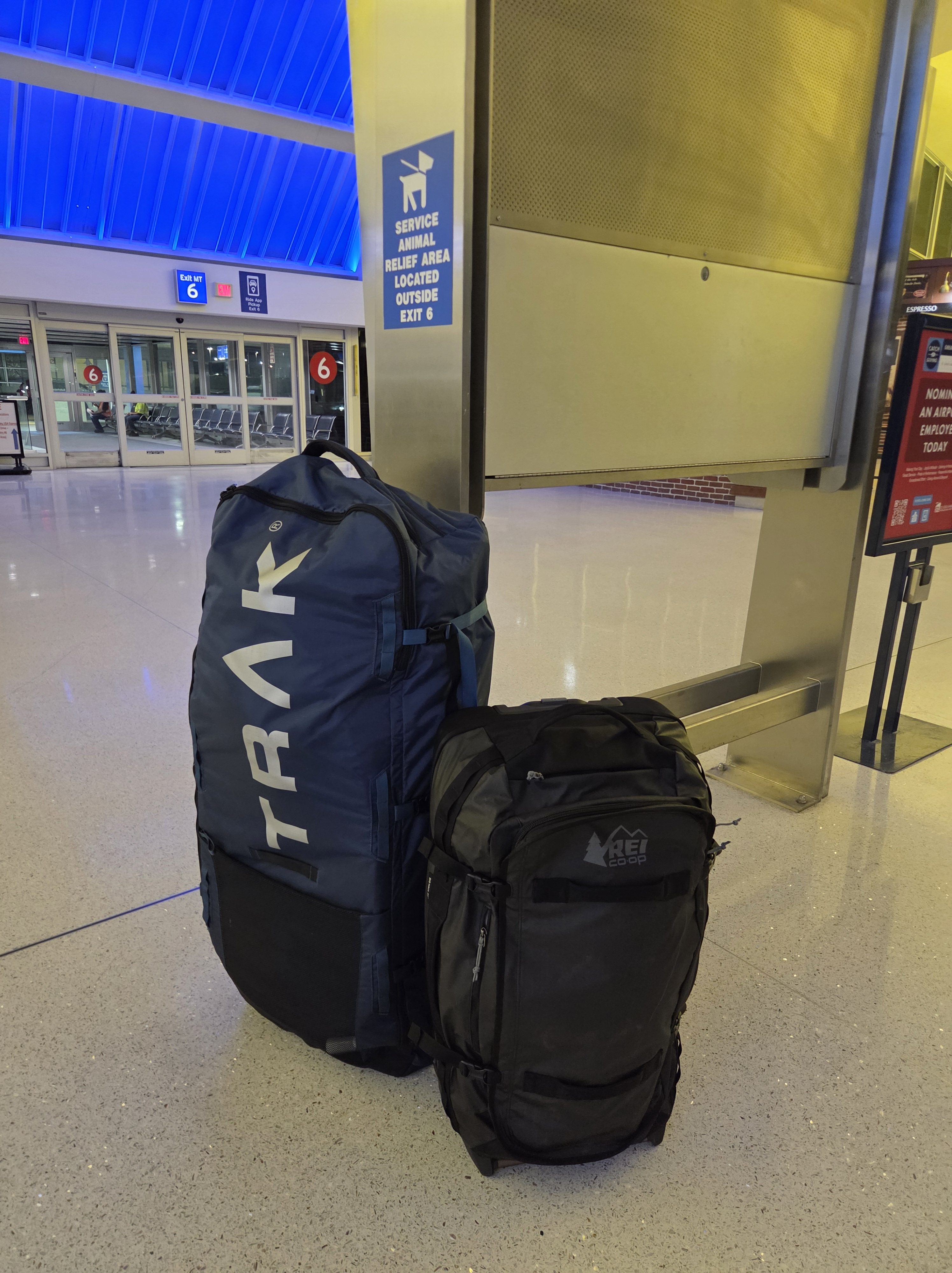
I packed my gear – my Trak kayak along with some of my paddling gear into the Trak bag then had another rollaboard for clothes and camping gear. I ended up paying a fair amount for the bags and the extra weight, but I learned a valuable lesson from my friend Todd who flew in from Cleveland for the trip: check to see if a higher class ticket, like business, includes baggage, because it might be cheaper to fly business with some big heavy bags than to pick the cheapest ticket and pay extra out the arse for the bags. 
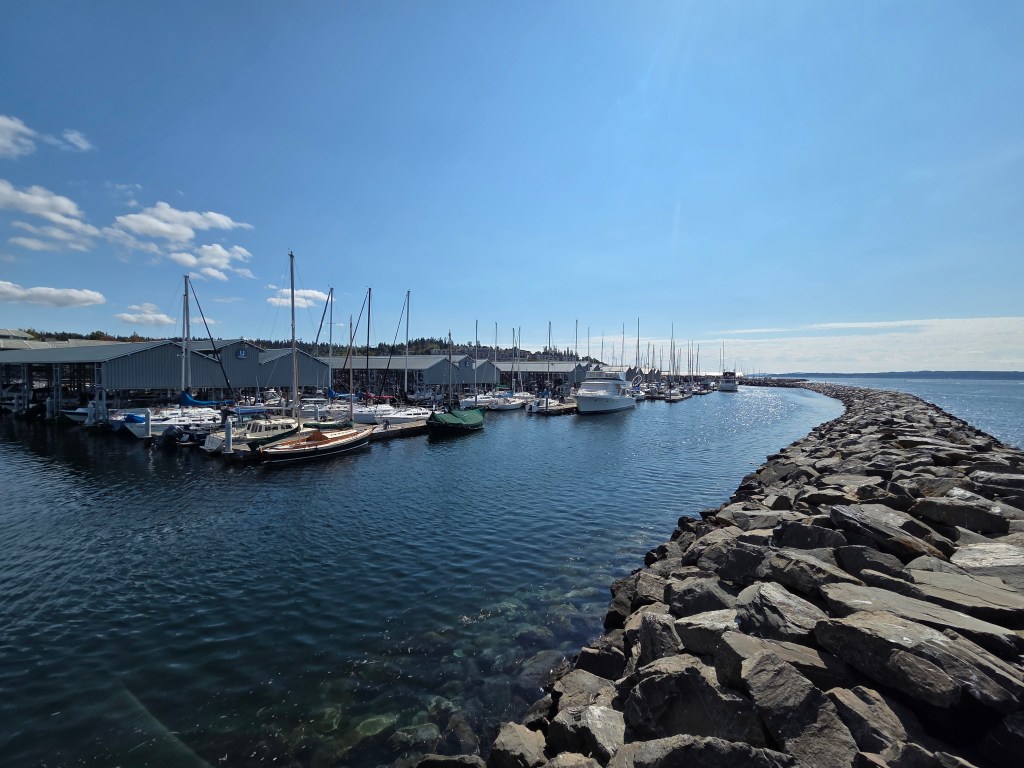
Flight to Seattle was smooth, then I hucked my bags to the Link train outside the airport and took the train north to just outside Edmonds, WA. Another trip participant, Rebecca, graciously offered to host me at her and her husband’s beautiful house overlooking Edmonds harbor before making the trip up to the San Juans the next morning. I spent the evening talking with Rebecca and Richard, with Rebecca telling me about her pretty industrious and widely-travelled paddling career. She’s been a Trak kayak owner since nearly the beginning of the company, 20+ years. 
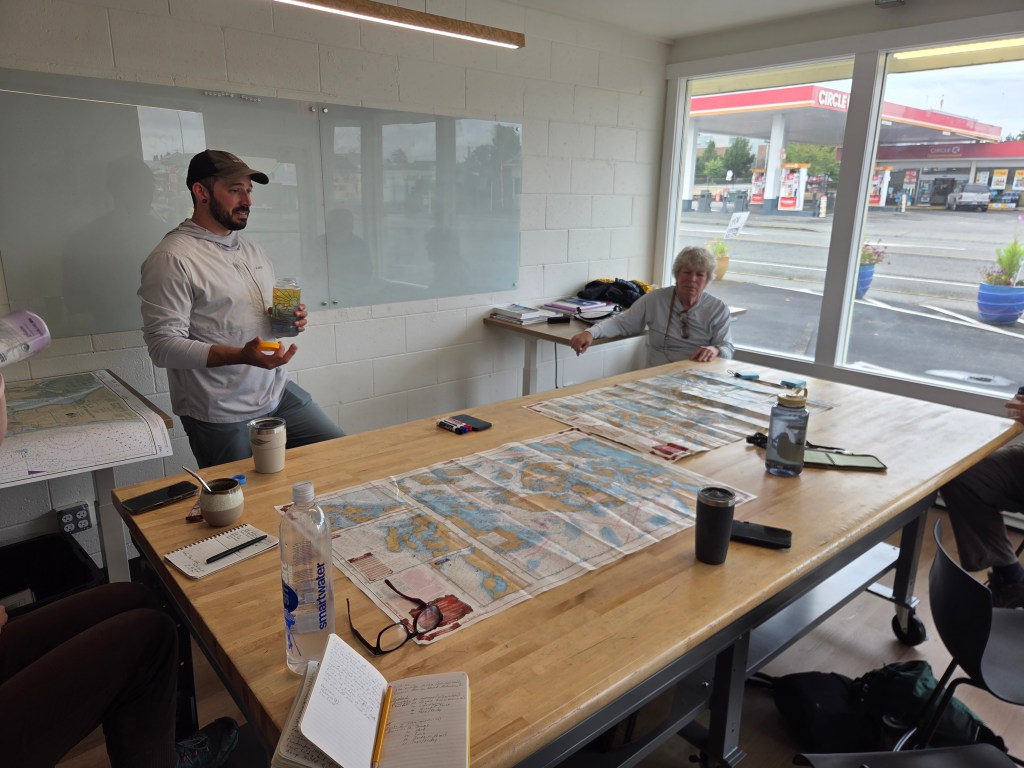
The next morning we hopped in Rebecca and Richard’s super nice RV and headed up to Anacortes, WA where we’d meet the rest of the trip paddlers and our guides. We walked into Body, Boat, Blade kayak shop and met our guides for the week Alex and Sasha. The other trip participants trickled in: Marilyn from Detroit, David from Chicago, Florence from Vancouver, Todd from Cleveland. Over the next couple hours, Alex laid out the trip, presenting us with different options for routes, gave us a crash course on ocean conditions, tides and currents specific to the San Juan islands and taught us some of the core terminology for ocean paddling. 
After lunch, we went to Alex’s house to put together our boats, packed our gear in our boats, and assessed how much room we had to spare to fit shared gear and food for the group for the week of paddling. Some of the crew had experience with Trak, others were just renting or trying out the boat for the week. I was pleasantly surprised with how little room my own personal gear took up, allowing me to throw some extra group gear in the boat. 

Rebecca drove me to a campsite for the night, which was conveniently where we’d be putting in the next morning. Hammock sleeping in the mid-50 degree temps under gorgeous northwest evergreens was absolutely divine after a summer of blazing STL temperatures. 

Day 1

I was up early the next morning and walked my boat down to the beach and started assembling my boat and gear as the rest of the group trickled in. Our target was to depart by 10am to catch the slack tide for a 5 mile crossing from Sunset Beach in Anacortes to James Island across the Rosario Strait. I was packed up pretty quickly, but some of the others took some time in getting their gear packed and into their boats. I learned another lesson right then, that just because I was settled with my gear and boat didn’t mean the job was done. We had to work as a team this week, to ensure everyone was prepped, ready to hit the water when we needed to, according to the tides. Missing a targeted departure time on the ocean can have consequences, which we were about to find out. 
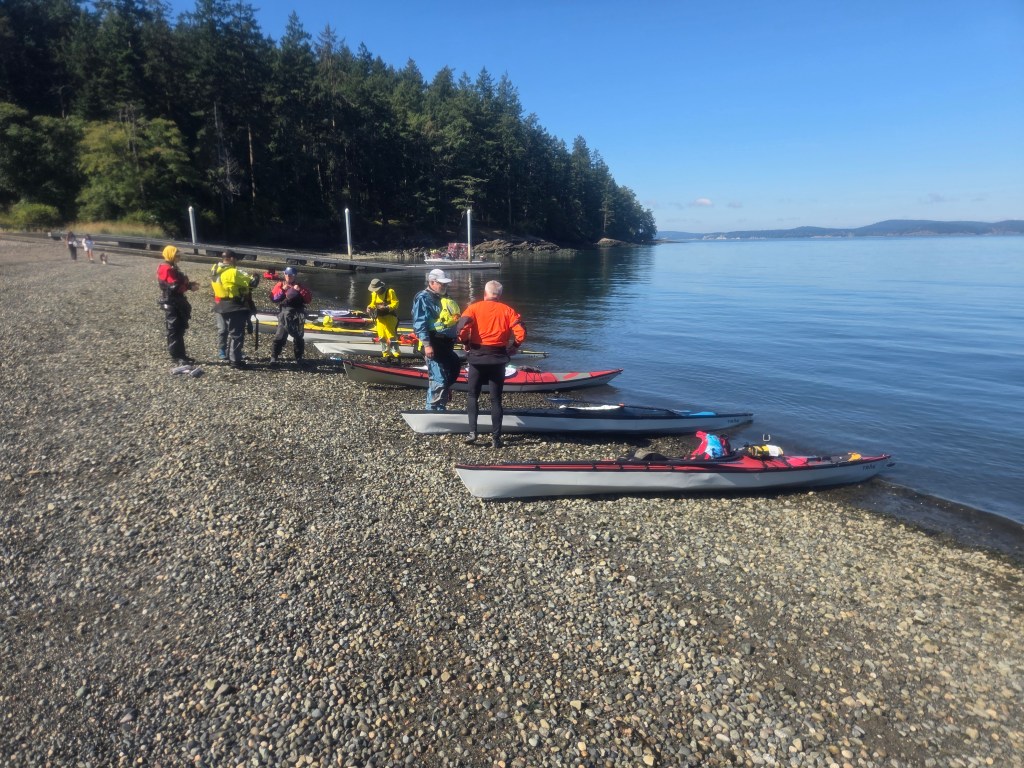
We departed the beach around 10:45, and David had an unfortunate flip which delayed us a bit further. Now our crossing was going to be in a flooding tide instead of slack, which meant paddling angled against the current to ensure we’d hit James Island. 

Luckily, the conditions were pretty mellow, low winds and little boat traffic. We spotted some Porpoises surfacing in the distance and were about halfway across when David flipped again. Alex and Sasha quickly helped him back into his boat, but in the effort, David was pretty exhausted. Alex had Marilyn tie up next to David for stability, then Alex and Sasha took turns towing those two into the current the rest of the way to James – a superhuman effort. Myself, Rebecca, Todd and Florence paddled ahead and landed on James before Alex and Sasha came in with Marilyn and David in tow. 

We had lunch on the beach then headed up the steep slope to pitch our camp for the night. After we were settled, myself, Todd, Florence and Alex did a late afternoon circumnavigation of James Island, only about 2.5 miles. I spotted a bike helmet floating in the kelp and I actually hauled it with me the rest of the week and flew home with it! Nothing like ocean treasure. I set up my hammock on a beautiful spot overlooking our beach and had a very enjoyable night sleep. 

Day 2

There must have been some wildfire smoke moving in, because I opened my eyes in my hammock to an absolutely brilliant sunrise over the Rosario Strait. After some coffee and standard breakfast of potato and egg hash, we packed up and started to load our boats for the day’s journey: cross to Spencer Spit for lunch, then on to Blind Island for the night. 

As our group got onto the water, David continued to experience instability in his kayak. After huddling with Alex and Sasha, David decided to end his trip early. Alex called a local water taxi to come retrieve David and his boat/gear as the rest of the group departed. Absolutely no shame in knowing when to pack it in, revisit gear and skills and attack the opportunity for a future adventure. Nice paddling and adventuring with you, David. 

Our group crossed through the gap between Blakely and Decatur Islands then crossed another calm channel to Spencer Spit, a really nice state park, where we chowed on our standard lunch of artisan crackers, summer sausage, cheese, avocado and tuna packets with tortillas. We also had the chance to refill our shared water dromedaries at a spigot. Leaving Spencer Spit, we got up close and personal with a curious seal, his heading sticking out above the water taking a look at us weirdos. The wildfire smoke was somewhat thick at times, and there wasn’t much of a breeze until we crossed around the northern tip of Lopez Island and got some decent southern wind-caused waves as we crossed over to Shaw Island. I pulled over on a small gravel beach for some relief and spotted a tooth just under the water – turns out it was likely a seal tooth!

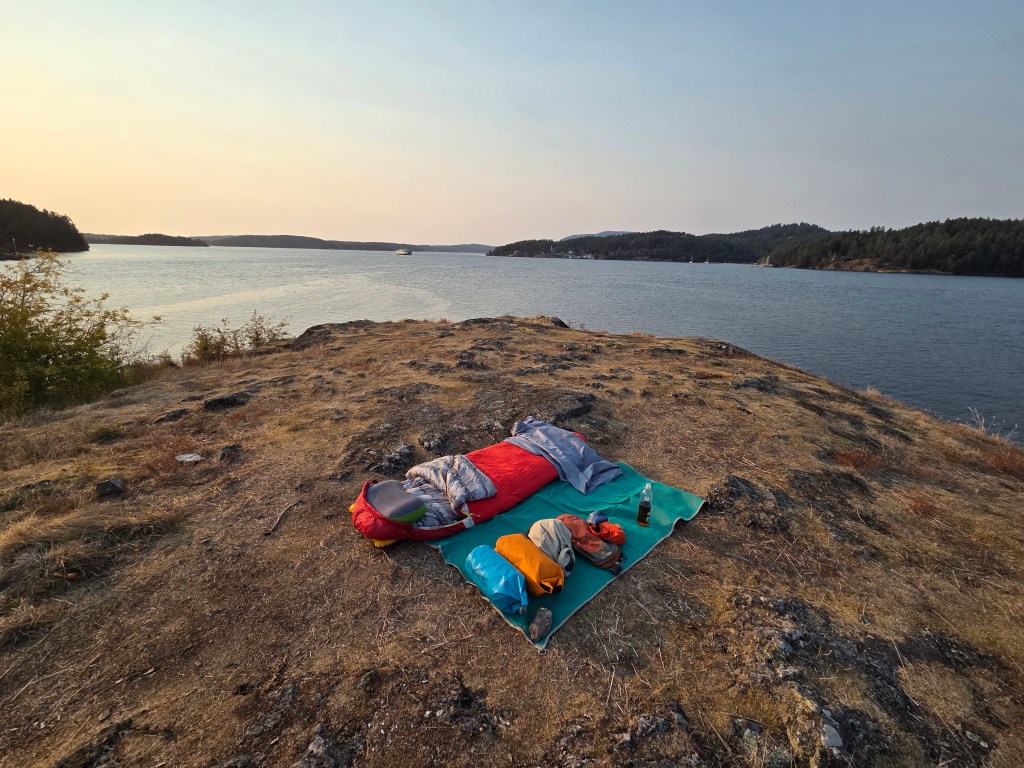
We paddled into Blind Bay then across to Blind Island, where we encountered another kayak trip of high school kids camping for the night. But plenty of room on this small island for us, Sasha knew the guides for the other trip. We unpacked, moved the boats up to higher ground, then prepped our camps before gathering for dinner. With very few trees on the island for hammock camping, I laid out my sand mat and got ready for open-sky cowboy camping at the most elevated point on the island with spectacular views of the surrounding islands and ferries landing and departing at Shaw and Orcas. 

After dinner, Alex and Sasha proposed for the next day that we keep our camp at Blind Island for a second night, then paddle our unloaded boats around the entirety for Shaw Island, a challenging 15 mile route in varying currents and conditions. The prospect of unloaded boats and skipping the camp breakdown and setup was very appealing for our group. I laid down in my million-star sleeping accommodations for the night. 
Day 3

This would be the longest day mileage-wise but probably my favorite of the whole week. We left Blind Island around 10am with light, unloaded boats. We took off around Shaw Island counterclockwise, first going with the flooding tide until we made the turn into the San Juan Channel where we were going against the current. Luckily, Alex had taught us the importance of catching eddies, a concept I’m very familiar with on rivers, but quite applicable in marine environments as well. Basically, we kept pretty close to the shoreline, and with the irregularity of land features on the coast, we can sort of hide in the shadow created by the current hitting these features and avoid paddling directly into a strong current. 

At one point, I looked out across the mile-wide San Juan Channel flowing with the flooding tide and other than the water clarity, very much resembled a strongly flowing Missouri or Mississippi. We also had to paddle up and over a riffle where the channel narrowed forcing the current to be constricted, a nice little adrenaline rush. 
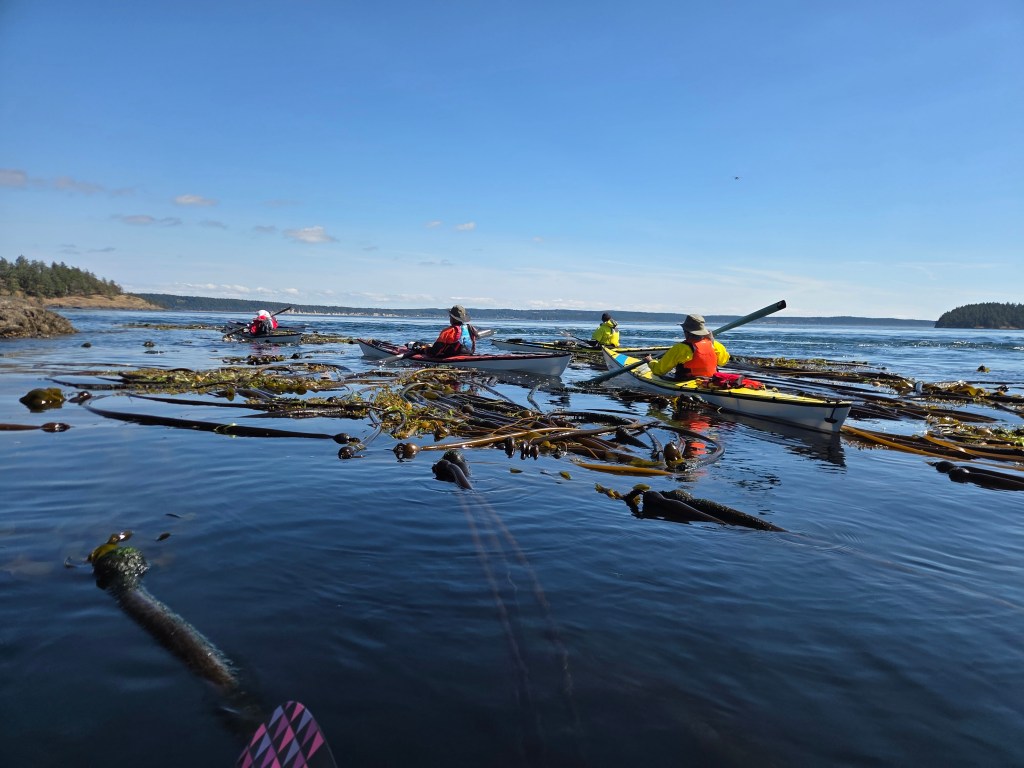
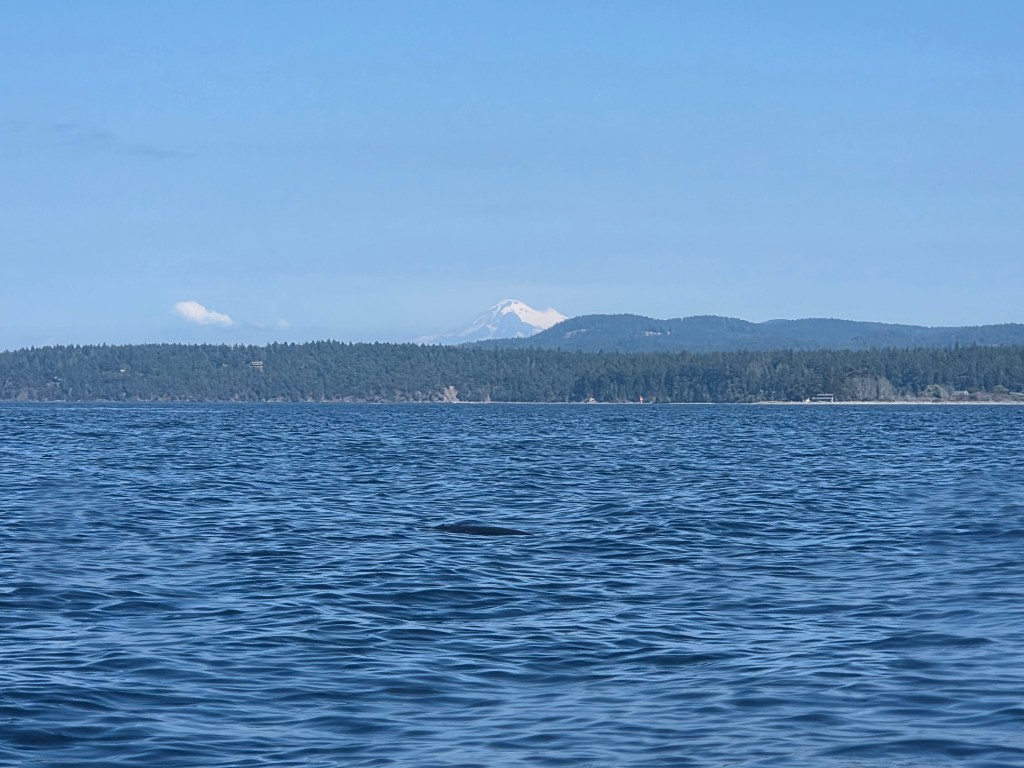
As we turned around the bottom of Shaw Island, I looked up and saw a snow-capped Mt. Baker in the distance. We’d been surrounded by beautiful mountains all week, but this is the first time we’ve been able to see one of the snow-capped peaks of the Cascade Range. Combine this with some pretty nice tailwind in this section, which allowed me to try a little downwind surfing in my Trak, it was an amazing homestretch for the day. We made our way back to Blind Island after a quick pitstop at the general store at the Shaw Ferry terminal for refreshments. 
After another delicious dinner (all our dinners were prepared by Alex and Sasha out of ingredients that generally don’t require refrigeration: rice, pasta, dehydrated or fresh veggies, vegetarian friendly proteins, canned chicken, etc. – every meal was delicious!), Alex asked us to plan the next day’s route to our next island camp on Jones Island. We huddled over a map, discussed different routes and considered the tides, currents, wind and other factors we’d learned to take into account so far in the week. Pretty empowering to immediately apply things you are learning to help plan the next leg of the trip, rather than simply following what our leader is dictating. We ran our plan by Alex and Sasha and other than a few comments or suggestions, our plan was not too shabby. 

Day 4

A pretty short and relaxing day compared to yesterday’s 15 mile circumnavigation, we headed west and passed through the narrow passage between Crane and Orcas Island into Deer Harbor. Stopped on a rocky beach for lunch before proceeding around a peninsula edged by beautiful homes perched on the rocky bluffs, then a short crossing to Jones Island. With an early afternoon arrival, plenty of time to set up camp, dry out wet gear, hike around the island to take in the incredible views (including distant mountains of Canada!), catch a nap and generally relax. 
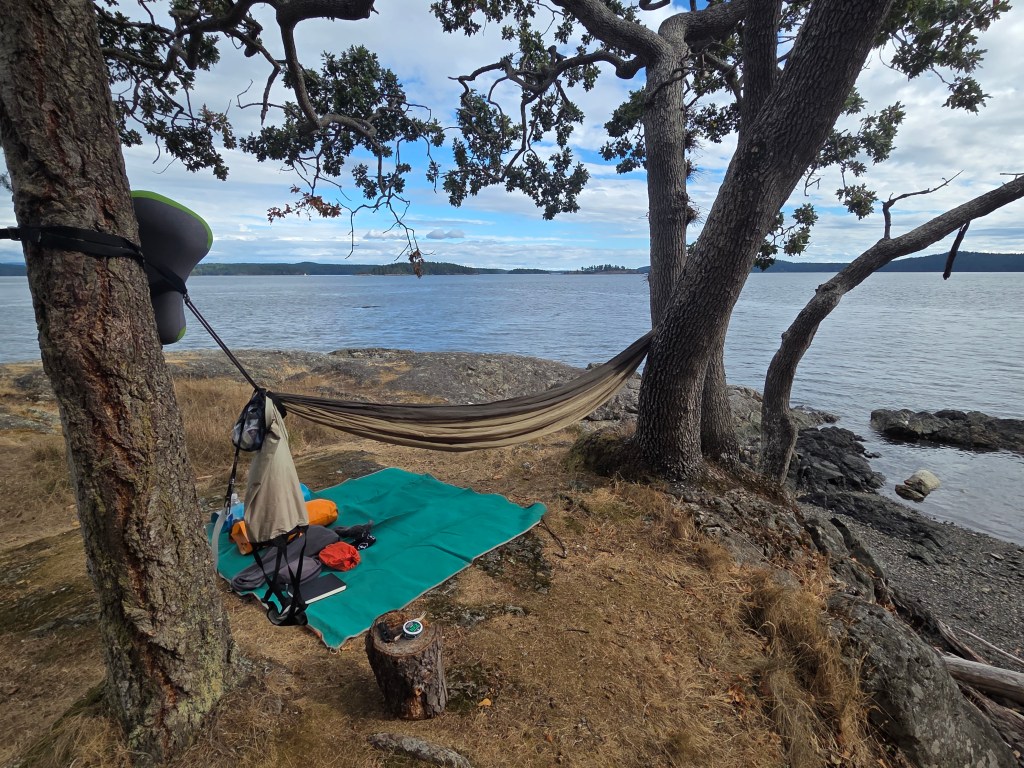
We gathered for dinner and discussed the plan for the next day, which would be our last full day of paddling. Not much planning needed for this route, as we had a pretty straight shot southeast down the San Juan Channel past Friday Harbor to Turn Island. The only challenge would be finding the ideal time and location to make the crossing of the wide channel, again taking into account the tide, current, boat traffic, wind and waves.

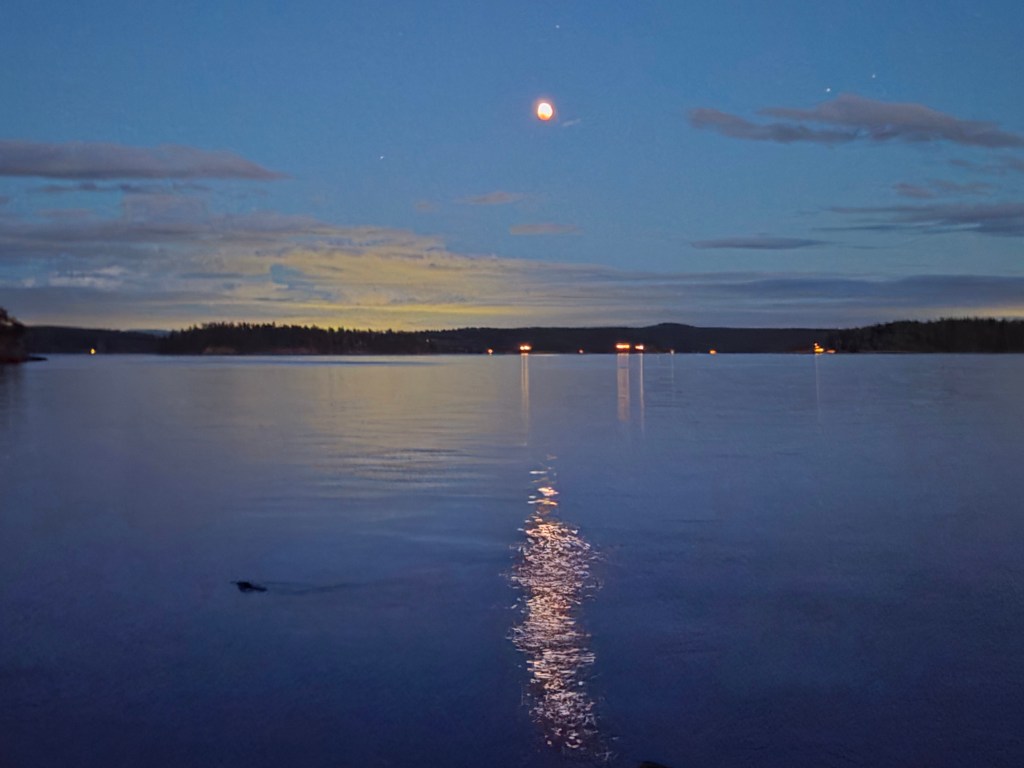
Walking back to my hammock camp after dinner, I noticed a two-toned moon, first thinking it was being partially obscured by clouds. I quickly realized there was some sort of eclipse going on, and confirmed it by looking it up on my phone. A curious seal swam right by in the reflection of the eclipse. Nature was really putting on a show this week, and I was there for all of it!
Day 5

Provided we departed early-ish, by 9am or so, we’d be hitting the ebbing tide which we could ride down the San Juan Channel to Turn Island. We were all pros at packing by now, and it didn’t hurt that our food supply packs were getting lighter by the day. We launched and crossed over to Yellow Island before beginning our crossing of the channel. Alex had prepped us for this by introducing us to using compasses to establish a bearing on a long crossing, and making adjustments along the way. I tried to follow the decided upon bearing using a borrowed compass, but as we got into open water, the south wind hitting the opposing ebbing tide kicked up some small but challenging waves so I didn’t have the ability to keep checking the compass. 

The group worked together to maintain our bearing and made a good crossing, getting into the shelter of the San Juan Island shoreline. I noticed that there was a lot of water inside my boat, and after pulling into a sandbar, realized a crack in the coaming of my kayak was letting in water every time a wave broke over the top of my boat. I emptied the water and was relieved this problem was presenting itself at the end of the trip vs. the beginning. We continued along the beautiful shoreline, crossed the busy channel into Friday Harbor, then over to Turn Island, our last camp of the trip. 

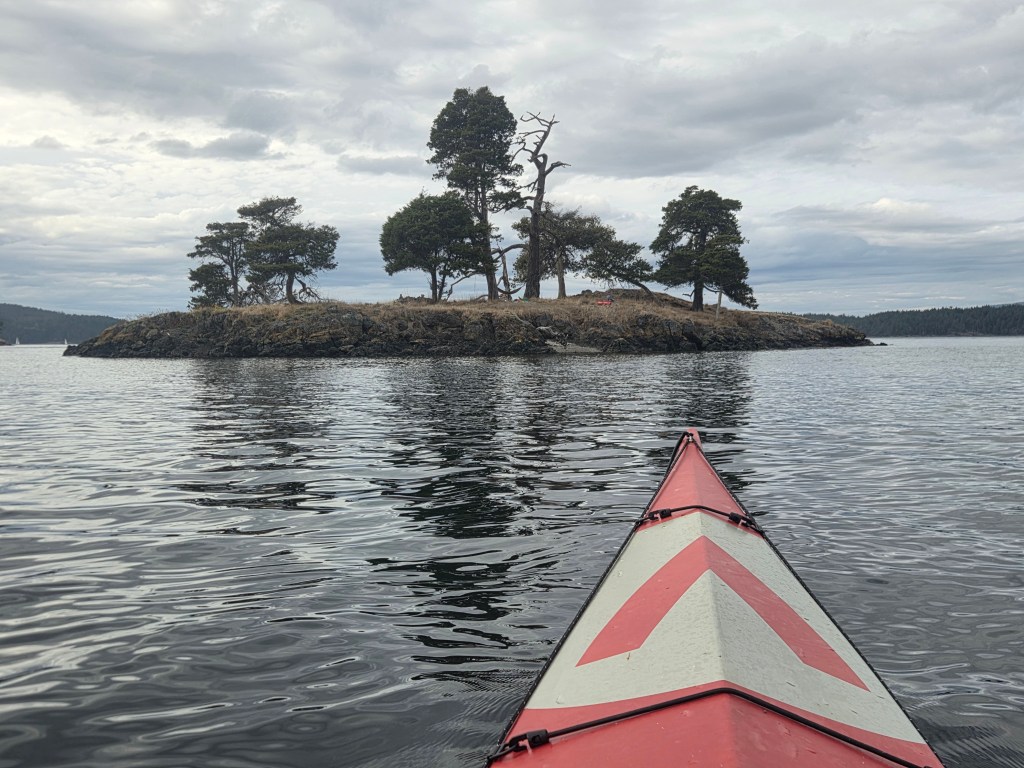
I spotted a small island off the shore of Turn and opted to set up my camp on my own private island for the night. At low tide, I was able to walk through a foot of water to get to it, but later in the day, I had to paddle my boat back and forth to camp. Before dinner, I opted to paddle around a couple of surrounding islands with Sasha and Florence, but didn’t make it all the way around due to the rushing flooding tide. All of us in the group were aware there was a chance of rain that night, fortunately the first precipitation of the week. I had avoided setting up my tent the entire week to the point, either hammock camping or cowboy camping directly on the ground. So I stubbornly kept the tent in the bag as I crawled into my hammock for the night on my private island. 
Sometime around 2 or 2:30am, it started to rain, softly at first then becoming steadier. I grabbed a tarp I had and draped it over the top of my hammock and that seemed to work great. I snoozed a bit more. Around 4am or so, I awoke to a cold, wet back, as the rain ran down the tree trunk my hammock was strapped to, then across the strap down into my back area, soaking my sleeping bag and clothes. I thought at first I might be able to sleep through it, but after starting to shiver, figured I needed to do something. I hopped up and very quickly set up my tent, dove in and put on a set of dry clothes I had in a dry bag. It was still cold, but better than soaking wet. I managed to sleep a couple more hours before getting up and packing up some very wet gear. 

Day 6

The final day of the trip was the shortest. All we had to do was pack up, paddle about 200 yards across the water to the access of Turn Point County Park. Alex had arranged for his van to be parked nearby. We would unload all of our gear, disassemble our boats and load all of it, and us, into the van for the ferry ride from Friday Harbor back to Anacortes. Just another amazing selling point of this Trak boat: We fit 6 kayaks, 6 people, gear and kit for those 6 people for a 6 day trip into a 12 passenger van. It was tight but it totally worked!

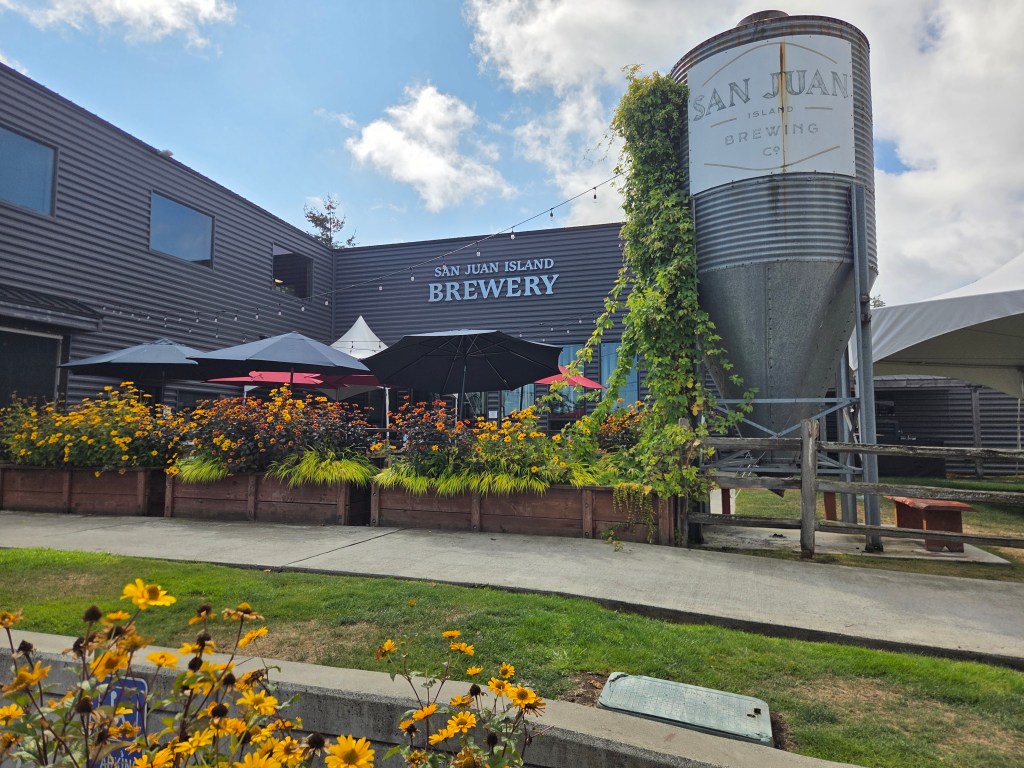
We headed back to Friday Harbor, where the weekend rush presented us with about a 4 hour wait to get on the ferry. I leisurely strolled around the very pretty town, eventually and unsurprisingly ending up at the San Juan Islands Brewery for a few cold beers and time to recollect and record an amazing week on the water. Alex and Sasha joined me for a bit and it was so awesome to hang out with them post trip to get their thoughts on the trip and all things outdoors and expeditions. 
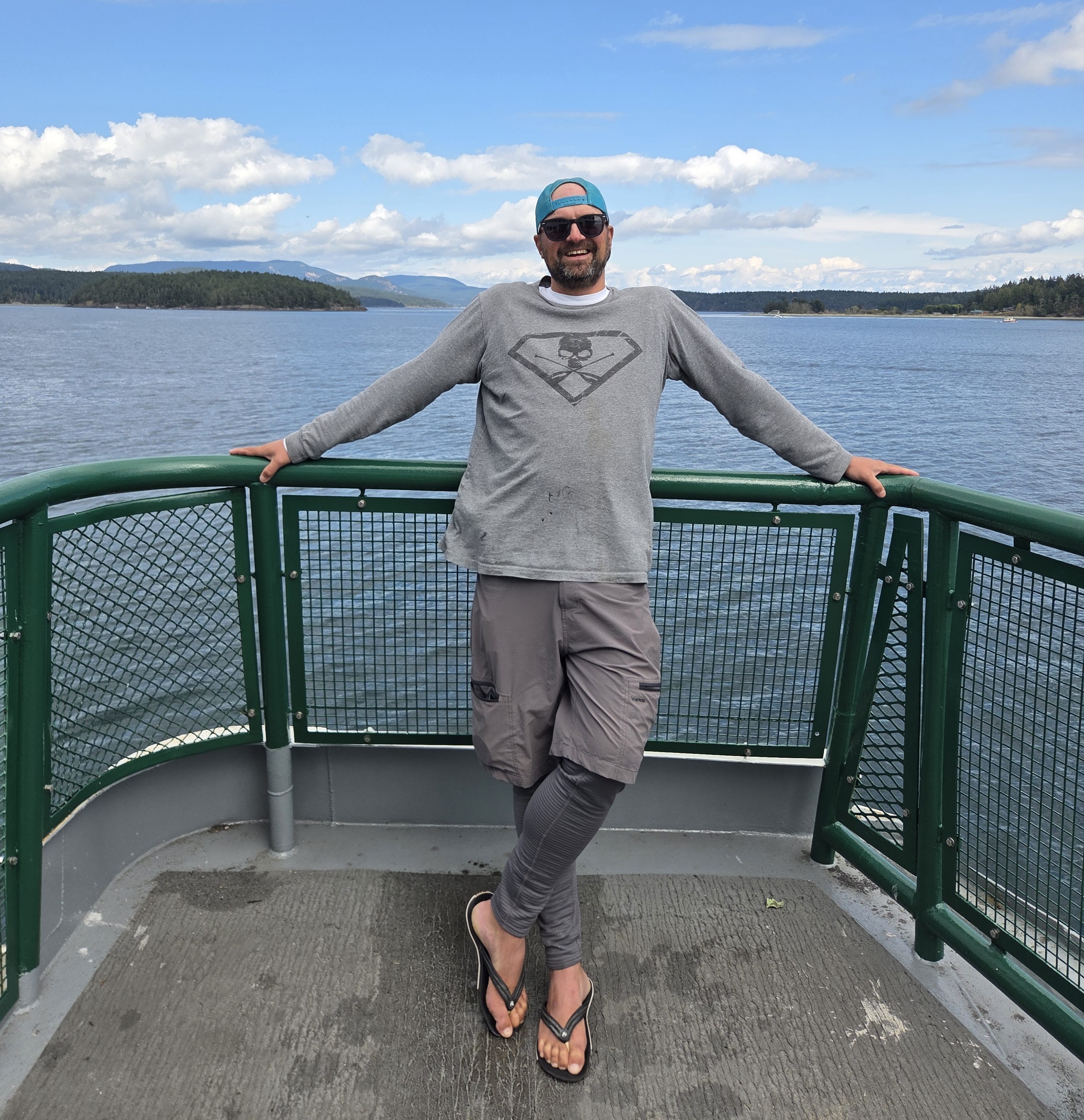
We hopped on the ferry back to Anacortes and most of us spent the time out on the deck in the brilliant sun and steady breeze, seeing all the islands we camped on and all the channels we crossed throughout the week. 6 days to get to our finish, 1.5 hours to get back to the start. 
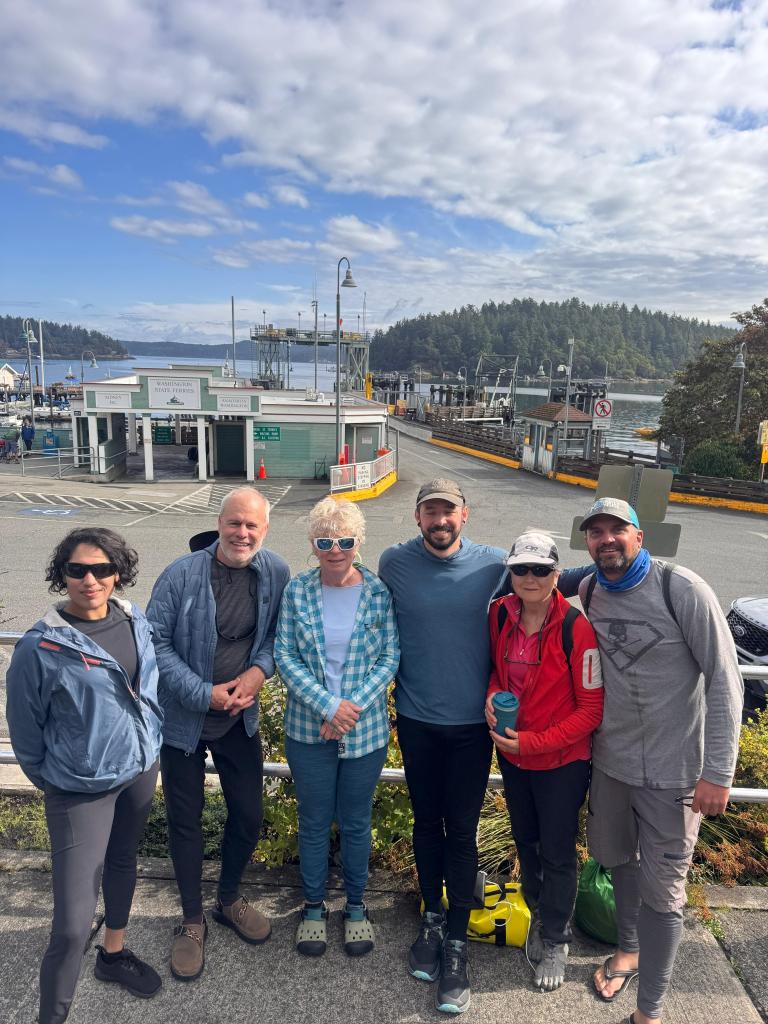
Back in Anacortes, we went back to Alex’s house to unpack all our gear, dry things out once again and prepare to travel back to our respective homes in a somewhat civilized manner. We said a few goodbyes to folks in our group, then Alex, myself, Marilyn and Todd went to a local dive for dinner and drinks, along with Leo, also of Body, Boat, Blade and his lady friend. Again, great to spend time informally debriefing from a trip to really bring perspective and appreciation for the experience. 

I can’t say enough about Alex and Sasha’s guidance and leadership on this trip. We were a group of paddlers with widely varying levels of experience, only one of whom had significant coastal paddling experience, also with widely varying levels of personality, and Alex and Sasha guided the trip professionally, effectively and to maximum satisfaction for myself and others on the trip. 

After the trip, I was asked by someone if I felt fulfilled. I had to say no, not really. I don’t feel like this trip was a culmination, but rather a small taste or preview of what kind of adventuring I might consider in the future. The Trak boat really opens up some interesting opportunities worldwide. I am already scheming, thinking about and planning the next one. Time will tell where I might be able to go. But a huge thank you to Alex and Sasha, Body Boat Blade, and Trak Kayaks for putting on this amazing trip!

mf
Race Report: 2026 MR340

Missouri River 340, July 28 – 31st, 2026

Result

#2341 – On the Piss Again – Mixed Tandem Division

70:12:50, 130th place overall, 9th in Division

Team: Mark Fingerhut, Kirsten McEvoy

Support: Brett Swanstrom, Big Muddy Adventures

Boat: Minnesota 3 canoe

Pre-Race/Prep

After volunteering at boat ramps at last year’s MR340, and loving every second of that, I decided to get back into the race this year. It would be my 8th attempt, and hopefully my 8th finish since my first race in 2010. 

In considering what boat I wanted to paddle and who, if anyone, I wanted to paddle with, I think my competitive juices drove some of my thinking. I checked out previous years race results, and noticed the mixed tandem division might be an opportunity to get close to the podium. My very unscientific analysis looked like if a result of 45 to 50 hours could be achieved, that typically led to a podium finish in previous races. 

With that in mind, I reached out to my friend Kirsten to ask her to join my team. Kirsten had 2 previous finishes in the 340, both in the Dragon boat division. Always one of the strongest paddlers on our previous dragon teams, she was an easy choice. That and her other hobby is beating the crap out of big men (and I assume some women) in full medieval battle armor. 

We had a couple training runs of around 55 miles in a borrowed Minnesota 3 canoe (huge thank you to Jim Hall!), including running the Chain of Rocks at 13ft on the St. Louis gauge. (A buddy Kevin took video of the lively run through the wild waves, and it kind of went viral with lots of lovely and very helpful comments from internet strangers.) We were feeling good going into the race. 

My thinking with the Minn 3, a boat designed for 3 people, was that with the extra room in the boat, one of us could easily lay down in the bottom of the boat to sleep while the other paddled. In theory, this would allow us to avoid lengthy stops on shore to sleep and recover. We’d follow the mantra of ‘stay in the boat’. 

We recruited our friend Brett, a very experienced MR340 racer as our ground support and we were set. As a river guide with Big Muddy Adventures, I was super lucky to have their team’s support for the race, including accommodation in KC for me and my team, transport to KC for me and the boat, and extra hands at the boat ramps all the way to St. Charles. Love all you guys and thanks so much for your support!

The Race

Monday in Kansas City was hot. According to the morning weather guy, the first day temps would hit 100 degrees in 3 years. I spent the day at the Big Muddy booth, helping out with our rental fleet and setting up borrowers with their boats and the necessary gear for their races. I was pounding water constantly. 

After our traditional pre-race Woodyard BBQ meal with some KC friends, we turned in, ready for the 5am wake up call. 

We arrived at Kaw point in cool weather and slight drizzle, an amazing relief to yesterday’s heat. Kirsten and I got our boat and gear set. Getting ready to put in down at the confluence point, I noticed a woman sitting by the shore starting to have a seizure. I yelled down to my Big Muddy coworker Pete, who was assisting boaters into the water, to check on her. He did so, then immediately told me to get help. So I ran back to the main ramp and grabbed Perry and Big Muddy Mike, who came running down to assist. Eventually a medic was called and everything worked out fine. A little excitement before hitting the water. 

We loaded in and visited with a bunch of friends waiting at the starting line for the 8am start. I absolutely love this time right before the start, slap happy nervous energy, seeing folks you haven’t seen in years, wishing them well, sharing a laugh all while knowing what pain and misery is in store. 

We took off among the crowd, always taking the far left route at the confluence to avoid the congestion lower down, and hitting the fast current of the Missouri sooner. There’s always a temptation to really sprint at this point in the race, naturally you want to be in front of the larger crowd and establish a good start. But we paddled swift and steady and comfortably, again spotting friends in other boats and greeting them here and there. 

It was a pretty typical first day compared with my previous 7 races. The clouds and rain in the morning slowly gave way to sun in the afternoon, the temps being quite comfortable, a godsend after Monday. We worked our way through downtown KC, La Benite, on to Sibley, Cooley Lake, passing Napoleon around 1:30pm. I could tell the current was much slower than it had been 2 or 3 weeks earlier when the water was around 10 ft higher on the MO, but I didn’t start doing any math or expectations setting yet. We passed Lexinton around 3:30pm then pulled into Waverly at 6:50pm. 

Kirsten showed some signs of distress when we pulled in. It might have been the deceiving nature of the heat and humidity, or potentially some nutrition related effects. Big Muddy Mike stepped in to help her recover a bit, and after a resupply of food and drinks, we were back out after 25 minutes. 

I calculated our arrival at Miami at midnight and sure enough arrived at 11:57pm, really enjoying paddling through sunset, twilight and moonrise. About an hour before arrival in Miami, Kirsten agreed to take the first shift to try to sleep in the boat. Our rough plan was that she’d sleep before Miami, then at Miami, she would take over stern paddling, I’d switch to the bow and I’d have a chance to sleep a bit between Miami and Glasgow. She lifted herself back over the front seat and laid on a sleeping pad in the spacious bottom of the Minn 3. She tried to sleep, but I could tell from her regular fidgeting that she wasn’t sleeping. It also didn’t help that she would have to climb back in the seat to pee, then climb back into sleeping position. At one point, I even led her through a sleep-inducing hypnosis technique I know, but to no avail, she wasn’t sleeping. 

Getting into Miami, we were both feeling pretty good, and were there only 10 minutes, getting resupplied and some words of encouragement from a crew of Big Muddy Adventures friends, who were there supporting another Big Muddy team of Roo, Natalie and Eliza. I hopped in the bow and Kirsten took over stern. I made sure she was comfortable with the ruddering and navigating via the RaceOwl channel tracking app before I went ahead and laid down for a nap. I was able to sleep for about a half hour and felt somewhat refreshed. 

Eventually, it became very evident that Kirsten was getting super sleepy, the inability to nap earlier in the boat was a problem. We tried singing some tunes, delving into deeper conversations, spending a few minutes chatting with other boats as we passed them or they passed us, but I was losing the battle to try to keep her awake. She was consuming caffeine drinks, but they didn’t seem to be working. I asked her if we needed to pull over to the side so I could again take over stern, and perhaps she could once again try to sleep in the boat but she insisted she’d be fine. 

Looking ahead to our ramps, we were due to hit Dalton Bottoms around 4am and Glasgow around 6am. We decided to push on to Glasgow vs. stopping to swap positions again at Dalton Bottoms, Kirsten insisting she could push on to get us to Glasgow. Feeling like I needed a bit more sleep, I laid down in the boat once again, Kirsten insisting she’d be fine. As I was laying there, I could tell her mind was devolving. She was humming tunes to herself to stay awake, talking to herself, encouragement to stay awake. I think even at some point she was reliving or playing out work conversations. Her mind state was very concerning to me but she was keeping the boat moving down the river. At one point I think I dozed off, then opened my eyes to see the moon above me in quite a different spot. Thinking I’d been asleep for a long time, I raised my head and looked over to see the lights of two boats passing us in the opposite direction. 

Me: “Hey uh, are we uh, going upstream?”

Kirsten: “Oh, yeah I think so, hold on.”

She was able to turn the boat to get back facing downstream. But that was it, I had enough. I got back in the seat, and immediately, I began scanning the shore with our light to find a place to pull over. I told her it wasn’t safe for us to be out here with her condition. Eventually we pulled into a wing-dyked cove with a pretty decent sand mound. I helped her out of the boat, then told her to lay on the sleeping pad on the sand to sleep. She was reluctant and wanted to continue, but I was firm. So I also took the opportunity to sleep, and we both slept on the sand from about 5am to 6am. With the morning sunrise, we got back in the boat and sluggishly made our way to Glasgow, arriving at 7:50am, paddling in with my good buddy Shane on his brand new self-crafted Timber Longboard SUP. It looked like he was suffering and ended up DNFing at Glasgow. 

Thankfully, Big Muddy Mike had moved down to Glasgow and was there to provide medical assessment to Kirsten. I told him what our night had been like, her mental state, and that we did get some sleep. We had some food, refilled drinks and feeling like we had a good hour of sleep under our belts, decided to push on, leaving Glasgow at 8:44am. 

I was feeling relatively good at this point, not overly exhausted and felt like I was hydrating and consuming calories sufficiently. I don’t think Kirsten was in the same place. She once again decided to lay in the boat to try to nap, but quickly decided it wasn’t going to work and hopped back in the seat. After that, despite my best efforts of singing loudly and making conversation, she started falling asleep repeatedly. It would go like this: I’d see her paddle stroke start to slow down, sometimes entirely missing the water with her canoe blade. She’d then start to lean, on her way to falling out of the boat. At that point, I would yell “HEY” quite sharply to snap her back to attention. One minute later, repeat the same. This happened no less than 20 times between Glasgow and Franklin Island. She unfortunately did not want to lay back down in the bottom of the boat to try to sleep. 

We pulled into Franklin Island at 2:46pm, and she immediately laid down on a blanket Brett had set up. I told Brett we were staying there for a minimum of 2 hours, then after that, we’d see how she’s feeling. I took a quick nap, waking up to a pleasant surprise of my good friend Dan the Can Man and epic adventurer friend Neal Moore. After only about 45 minutes, I saw Kirsten groggily rise and I pretty firmly, maybe somewhat rudely told her to go back to sleep, please!

After a little more sleep, she woke up and told me and Brett she was done. She didn’t get good rest trying to nap there at Franklin, and I was pretty insistent that it wasn’t safe for her or me out on the river with her present condition. She didn’t feel confident in being able to get back to a steady or rested state with more time at Franklin. So that was that, either our race was over, or I was going to push on in a 3-man canoe by myself. 

Kirsten remains in my mind a stellar paddler, a complete badass woman, a great MR340 partner, a true adventurer down for anything. I have no regrets about having her as a partner. We got dealt some pretty rough conditions with the heat and slower than expected current. She persevered, pushing her mind and body to the limit, but it just wasn’t to be this year. I appreciate you, Kirsten! You’ll be back again to complete the 340. 

Continuing Solo

We were just about at the halfway point of the race, distance wise. My partner was out. I could be out. What kind of a terrible idea is it to paddle a 20 foot lightweight canoe, designed for 3 people, by oneself the remaining 170 miles of the race. I had finished my 7 previous attempts at the MR340, never DNFing. I’ve faced some very dire situations in my previous years, and this was now one of them. Selfishly, I wanted to keep my record of no DNFs in tact. So now it was time to figure out how I was getting to the finish. By the rules of the 340, you must complete the race in the same boat, cannot swap in a new paddler, and a paddler who has dropped cannot later re-enter the boat. How would I need to set up my boat so that I could navigate it solo?

Well, let me tell you about my buddy Neal Moore. A couple years ago, he solo paddled a tandem canoe across 22 US rivers over 2 years, from Astoria, Oregon to the Statue of Liberty. (This legendary trip will be available soon as a book written by Neal, and I cannot wait to read it.) Neal might be the most uniquely qualified person in the world to assist me in this current moment, and there he was at Franklin Island, a convergence of epic river magic. 

Neal helped me, Brett and Dan figure out how to add weight to the front of the boat to keep it trimmed out without the weight of Kirsten in the front. We decided on a full 5 gallon water jug, then located about 7 or 8 football-sized stones from the bank rip rap. I laid the sleeping pad in the front of the boat to protect the kevlar from the rocks. Floating the boat at the bottom of the ramp, I was happy with the trim, as were my observers on shore. I bid farewell to my team and was back out at 3:44pm to tackle the remaining 170 miles solo. 

From Franklin down to Rocheport to the Manitou Bluffs down through California Island, Eagle Bluffs then into Cooper’s Landing is probably my favorite stretch of the race. It’s a mini conglomeration of so many features of the entire river: huge bends, towering bluffs, wind-swept straightaways, sprawling sandbars, topped off by a raucous party at Coopers. I settled into a comfortable pace, about 1mph slower, rocks not being able to paddle as efficiently as Kirsten. With my new setup, I was consistently being passed by other paddlers, so it was really fun to chat with them as they passed, some wondering why I was paddling this huge boat by myself. 

I stopped at Cooper’s for a quick re-supply at 8:23pm. I was energized by seeing a bunch of friends, Big Muddy compadres, and was even sang Happy Birthday (guess I didn’t mention day 2 of the MR340 was my 46th) from the ramp as I paddled back out into the current. Can’t say my eyes were dry at that moment…

I was pretty sure I wasn’t going to make it all the way to Jeff City without needing to sleep, but I was sure there were sandbars I could stop at for some sleep. Directly across from the Marion access, I located a great sandbar, pulled my boat in, slapped down the sleeping pad and was out quickly. I slept from around 11pm to 1am, waking up pretty dang refreshed. 2nd night in a row sleeping on the sand. Pretty sure I’m now a convert for future MR340s. Crowded, loud, chaotic boat ramp naps are out; spacious, silent, pristine sandbars are in!

I reached Jeff City at 4:22am and was delighted to see my good friend Bernie Arnold faithfully working the ramp. I loaded up with more food, water and was off into the approaching sunrise. Jeff City to Mokane can be monotonous, but I really enjoyed it, taking in the emerging light of the day, having a great conversation with Richard (10 MR340s in a row in the same boat, finishing in the 40, 50, 60, 70 and 80 hours ranges, that’s incredible!) Caught up with my local STL paddling buddy Kevin who updated me on the status of a lot of our other Creve Coeur Lake paddle friends. I was shocked at the number of them who had to DNF already. I had a small sense of pride I’d decided to push on – maybe it wasn’t an idiotic idea. I passed Mokane then stopped for a morning constitutional on a mud bank, only to realize I left my belt PFD sitting on the front seat of the boat, while I was sitting 18 feet behind it. Luckily, just then a nice fellow Will from KC pulled up and he was able to hand my PFD back to me. We then shared some miles and great conversation, him learning of the race by being near Kaw Point at the start last year, going to see what the crowd was about, then entering the race the very next year. Amazing. 

By around 1pm, I was approaching Hermann and experienced my first significant headwind in the solo portion of my race. I quickly learned that handing this big light boat solo in a headwind requires much more effort, stressing my already aching muscles, lowering my speed by 1 to 1.5 more mph, and generally frustrating the hell out of me. 

I pulled into Hermann, and very logically told Brett and now on the support role Kirsten, that I was going to check the wind forecast. If it looked to be sustained headwinds for the next few hours, I was likely out of the race, or at the very least waiting until the wind died down. I wasn’t emotional about it, it was a simple logical choice. Paddling in the headwinds would push me to the point of exhaustion, adding many hours to the journey, to the end goal of proving what, that I  was such an awesome paddler that I finish every 340 that I start? Fuck that, I don’t have to prove anything to anyone! Did I mention your mind space gets really screwed up out there??

Just then Mark Malko, head river guide at Big Muddy showed up, and I asked his professional opinion about the wind forecast. He had a more detailed wind app than I, and told me it looked like there would be headwind for a bit, but I could expect shifting directions in the stretch from Hermann to New Haven down to Washington. Silently, not the answer I wanted to hear. I was really ready to quit, and I had the built in excuse of failing to solo paddle a 3-man boat into gnarly headwinds. People would understand and wouldn’t think less of me. Again, fucked up mindspace. 

So I took a quick 30 min nap, downed half a burger and jumped back in the boat, added a couple more stones to the front of the boat to try to keep the nose lower profile in the wind. This was the home stretch, having paddled stretches from here to the finish dozens and dozens of times in my life. 

I soon started cursing Mark Malko for giving me the information that got me back out here. After Berger Bend, the wind returned, pushing me sideways whenever I took a moment’s rest from paddling. And getting the boat turned back into the wind took every bit a strength I had. 

At what was certainly my lowest point of my race, my buddy Bryan paddled up to me with his partner, asking how it was going. 

Me: “Shitty. This sucks. I fucking hate this.”

Bryan: “But you’re gonna finish.”

He handed me some caffiend Gu and paddled off. Goddammit Bryan, you asshole, you turned it around for me right there, 4 words was all it took. I realized he was right. No easy way out, I was going to finish. Things really improved from there. I needed motivation, which can only be provided by putting on NOFX’s classic punk rock opera The Decline, a 17 minute heart pounding anthem, of which I know every word. I didn’t care a lick who else heard me screaming this song, the blood was flowing and I was back in the game. 

Approaching New Haven, who do I see paddling upstream on SUPs but my ride or dies Shane and Dan. We recounted our race experiences so far, with Shane recovering from his Glasgow DNF and Dan working overnight on the ramps. At New Haven, Shane’s lady friend Becky and Neal were there to ply me with cold coffee and Pepsi. From here on in, I was going to need a steady flow of caffeine. The headwind continued to Washington, but I was motivated and made good progress, even if I could tell my brain was still foggy. 

I pulled into Washington at 8:31pm and was delighted to see my Washington mainstays Pat Tenny and Judy Feltmann. I told Kirsten and Malko and I needed significant sleep and they of course understood and were accommodating. By this point, Brett had to leave support duties to travel out of town, so handed off to Kirsten. She had retrieved her minivan, so set me up on the mattress in the back of her van, pumping the AC while I slept for 2 hours. 

I woke up at 11pm, felt my mind had cleared up, was good physically and was ready to finish this thing. Leaving Washington, who do I meet but Ryan from Kansas City, who was also paddling a tandem canoe solo, his bow also filled with rocks and sand! We shared the stories of how we both got to this point, me realizing that I wasn’t the only one going through this unique challenge and suffering, Ryan having done this from even further up at Miami, where his partner dropped due to back issues. We pulled into Klondike and were greeted by my good paddling friends Bob, Cora and Myron, and of course ice cold Klondike bars. Such an amazing and unique perk from this legendary paddle stop, thank you guys so much. 

Ryan and I took off again. A solo canoe paddled up to us, and I didn’t realize at first I was chatting with my good friend David Falterman. I’ve known David, his legendary sister Ellen, and have met their amazing parents a couple times over the years. I was delighted to catch up with him and hear his updates and encouragement. He also made me realize that I’d get to experience one more sunrise before the finish, which motivated me to make it through the darkest hours of the night, knowing I was getting a bonus 3rd sunrise on the river, something I didn’t anticipate going into the race. A silver lining to the unique challenges presented so far. 

I hit all the familiar sites coming into Chesterfield and St. Charles, having a 4am conversation with my departed friend Aaron Duenke at Johnson Island. I know he’d laugh his ass off at what a predicament I got myself into, but I know he’d also be urging me on to finish. Miss you, friend. 

I was ingesting a lot of caffeine on this stretch, the Gu Bryan had given me, the Pepsi, a Coke from Judy at Washington. With the last 2 bridges to go, I probably ill-advisedly washed down 2 ibuprofen with Coke, but I needed to fuel the final sprint. I paddled alongside Mark from Kirkwood, then started my closing sprint at the 364 bridge, screaming more punk rock and fully pumped with adrenaline. Don’t even ask me what my heart rate was at this point, I was going to finish this thing. I sprinted into the finish, arriving at 6:12am, 70 hours and 12 minutes. 

Kirsten was there, as was Kent Schmidt working the ramp. Kent donated a massive amount of cash to my fundraising effort, and I was delighted to be able to properly thank him for his generosity. As we moved my boat out of the water, I chucked the rocks from my bow into the ballast pile Ryan from KC had started after finishing a few minutes ahead of me. We congratulated each other on finding a way to complete this thing with ingenuity and grit in trying circumstances, taking a picture with our ballast rocks and deeming ourselves The Ballast Brothers. 

I also had a great moment with Big Muddy Mike, who congratulated me on sticking it out. I told him how much I appreciated his care for Kristen during the race, and just being there for us seemingly on every ramp, somehow. I can’t describe how lucky I feel to be a part of the Big Muddy family. 

Kirsten brought me a cold beer, we took a picture under the finish line banner, then she drove me home to my bed. Every year I’ve done this race, there is a new challenge, a new set of problems to be solved, a new series of obstacles to overcome to get to the finish. I don’t care to be seen as a beast who finished the second half of the race solo. That absolutely wasn’t happening but for the support I received at so many points along the way. My finish belongs to those people, my appreciation to every one of you/them will last forever. So thank you, sincerely. And now this post is almost as long as my race, so I’ll leave it there. 

Odds and Ends

I ended up paddling almost exactly 170 miles with Kirsten in about 30 hours, the next 170 miles solo in about 40 hours. 

My nutrition this year was pretty different from my mostly solid food plan of years past. Most of my calories were in the form of Heul powder meal replacement shakes. 2 or 3 times a day, I mixed an 800 calorie portion which kept me hunger-less for a few hours. (For advice to fellow racers, you absolutely MUST consume what you will be consuming on the race BEFORE THE RACE. Do not attempt any new regimen or product during the race, or you will fuck yourself up, guaranteed.) I supplemented this with bananas, fruit snacks, uncrustables, a couple ramp sandwiches here and there. But the nutritional MVP for me was boiled peanuts. I shit you not. My good friend Zach Smith boils his own nuts, and not only that, seasons them with Red Hot Riplet seasoning. Throughout the race, I’d pop some nuts into my mouth, extract the soft salty nectar and enjoy the protein-packed morsel before feeding the shells to the catfish and carp who live down below. I highly recommend Zach’s Briney brand boiled peanuts as an endurance paddling essential. Thank you Zach, you have great nuts!

SYOTR

Atchafalaya River, Mile 46 – Almost There

Sitting here at the Riverview RV Resort, which is the last vestige of civilization before entering the vast Atchafalaya National Wildlife Refuge. Nothing but swamps from here to the Gulf. No sign of gators yet, we’ll see if that changes. 

The Atch has been very beautiful so far, but it is pretty slow compared to the Mississippi. If there is any current at all, it is maybe half or 1mph. If I ain’t paddling, I ain’t moving. I covered around 26 miles so far this morning from my slopeside campsite. It started out clear this morning, but then the fog rolled in, and I was paddling with around 1/10 of a mile visibility. Barges aren’t really prevalent on this river, so I felt safe enough. And I stayed within sight of the bank in order to make sure I’m still going downstream. Ask me how I know to make sure you are paddling downstream. 

Since I last posted, it’s been a fantastic week of lower Mississippi paddling, Tons of sandbars, even more barges, a fantastic afternoon/evening in Vicksburg complete with food, beer and a hotel room – shower most importantly. A day and a half later, I made it to Natchez, where I spent some quality time at a few establishments “Under the Hill”, the area that in its past was notorious for debauchery, criminality, in other words, where all the fun was happening in riverboat times past. I sat down next to a nice guy named Gene at the Old Magnolia grill, who was heavily invested in the Ole Miss/Oklahoma football game. I cheered along with him to an Ole Miss win, then after, he offered to drive me up the hill to Natchez Brewery where I scored a couple crowlers of their finest swill. Tasted amazing on the sandbar that night. Speaking of that night, I saw storms in the forecast, but didn’t assume anything severe, so I picked a campsite out in the middle of a sandbar instead of somewhere more sheltered. Well buddy. Around 11:30pm, it started storming. Rain, thunder, lightning – luckily the wind wasn’t insane or my tent probably wouldn’t have held. My tent being of quality material, but well-travelled, the roof leaks, so MacGyver over here put up the umbrella inside the tent to deflect water off to the side versus on me. It worked pretty well, I slept for a few hours in the fetal position under the umbrella, and only ended up with an inch of water at the low side of the tent in the morning. 

I entered the Atchafalaya River system yesterday morning when I made a right off the Mississippi and went through the Old River Lock. This system of locks and diversion structures actually channels 1/3 of the Mississippi River flow into the Atch. Hard to tell, as there’s been not a bit of current as of yet. I’ve read a lot about the Old River Lock system, and how massive and critical a piece of infrastructure this is. Without this lock system, the Mississippi River would assume the Atch basin as its natural course, and the Mississippi through New Orleans as we know it today would be reduced to a trickle. The resulting effect on shipping, industry and America’s economy, to say nothing of New Orleans’ fate, would be disastrous. So the Army Corp of Engineers maintains the lock system to ensure the Mississippi stays where it is. In flood years of the recent past, the Old River Lock system has been in serious jeopardy of failing. And there’s no putting the genie back in the bottle. Once the river goes where it wants, there’s no going back to what was. So we hope against hope that the Old River Lock keeps doing what it’s doing, the government budgets a not enough amount to maintain the system, though the river is undefeated so far since the beginning of time. 

In about 50 miles, I will pull off the Atchafalaya and enter 6 Mile Lake, then a man-made diversion channel. Then I’ll get into Hog Bayou, where a meandering channel will take me the last few miles to the Gulf and to Burns Point, where I’ll end my journey. 

As I mentioned previously, I do have a bit of regret that I am on a timetable for this trip. A trip like this should be done open-ended, leaving time to explore, take a relaxing day off on a huge sandbar, stop into towns and learn as much about their rich histories as possible. This has been a paddle-heavy trip for me, probably averaging about 45 miles a day. Just the nature of how the trip came about and other assorted logistics. Alas, any river travel is second to nothing in terms of adventures in my book, but I don’t consider myself a paddle racer first and foremost. I live for long meandering expeditions and deep exploration and spending time with the people and at places along the river. 

Pretty soon, I’ll be at home, it will be freezing outside, I’ll be thrust back into the realities of a civilized existence, so I am going to soak up every second and every paddle stroke of these last few days. I thank you all sincerely for reading. I will likely share some more reflections after the trip. For now, I’m going to drink a few more cold beers, wait for it to cool off, and maybe get back on the river for a few more miles before the Lousiana storms roll in tonight. 

See you all down the river. 

mf

On Paddling into a Headwind – Greenville, Mississippi

Sitting at Warfield Riverfront Park just outside Greenville, MS on a grey misty morning. I wanted to get to this park last night to camp, but in hindsight, I think a pristine sandbar was a better choice. It’s fine, it’s got designated campsites, electric, water and bathrooms, but seems pretty muddy and dank compared to a nice sandy beach. Plus all these trees and pavilions give me a little claustrophobia after living on the wide open sandbars for the last 20ish days. 

I got a bit of rain and some lightning from 4am til about 7:30 this morning, so got a little later start than normal, but the wind promises to be calmer and maybe even a little tailwind today, so am gonna get back out there for more miles after charging up some batteries. 

Wanted to give a bit more description of yesterday’s paddle day with stiff headwinds all day, and what that means to a big river paddler. Three days ago, the headwind was likely 20 – 20mph, which at that point, even with hard paddling, you are unlikely to make more than 1 to 2mph paddling hard, and that’s slower than the current. So best not to be paddling in that. Yesterday, with 10 – 15mph headwinds, I could still make decent progress with hard paddling, maybe 4-5mph, where with no wind, I’d probably be doing 5-6mph. So it was doable, not enough to take the day off. 

When paddling into that 10-15mph headwind, you are going to see whitecaps. In my boat, those waves rarely splash over into my cockpit, so I have yet to don the skirt that would cover my lower body and keep the water out of the cockpit. Most of the time, I am gauging where the wind is blowing from, then try to find the most sheltered part of the river to paddle in to minimize the stiff wind in my face and paddling into waves. If the river is bending, you paddle over to the side that is somewhat sheltered from the wind and you find calmer water, theoretically. Of course the sides of the river tend to be where the slower water is, so there’s that tradeoff. Then once the bend ends, you need to cross the river to the other side, where you might find more sheltered water, and you deal with the worst of the waves and current out in the middle of the river, all while watching for passing barges. 

You also cannot stop paddling, lest your boat turns sideways and now you are being pushed upstream, actually losing miles. My last 3 hours of paddling yesterday was on a straight section of river, thus no curves or banks to block the wind, it was hard paddling straight into the waves. My shoulders and arms were cooked come 5:30pm. 

For better or worse, probably worse, I did put a hard cap on my finish date on this trip, which is Oct. 30th at the Gulf. There I will meet someone to drive me and my boat back to New Orleans where I’ll rendezvous with the national community of Hash House Harriers for some halloween weekend debauchery and running. So I am motivated to get miles each day, minimize time off the river wherever possible and keep making progress. 

One other interesting phenomenon I noticed the last couple days. When paddling, what seems like very far of in the distance is a huge mid-river sandbar. Not that unusual, the from what seems like a distance of 5+ miles, the sandbar looks immense – like 8 – 10 feet high and a perfectly rounded shape. After a couple minutes of paddling, you soon realize that sandbar is only about 1 mile away, and it’s only about a foot high. Barely out of the water. Not a great idea to camp on these guys, as you’re likely to get swamped by a big barge wake, or heaven forbid you get a foot rise in the river level overnight. 

My next town I plan to stop at is Vicksburg, MS, around 98 miles downstream. By then I will have left Arkansas and will be in the great state of Lousiana. Onward and downward, with hopefully a nice tailwind. 

PS – as I was sitting here typing, a friendly camper came over and handed me a bag of sandwiches, donuts, snacks and drinks and told me God bless when I told here where I was headed. Doesn’t look like any beer, but I’ll take what I can get. River angels provide. 

mf

A Windy Day for Hunkerin Down

I’ve been back on the river for 6 days since my visit to St. Louis. In that time I’ve paddled 216 miles from Caruthersville, MO down to my spot on this island near Fair Landing, AR. 

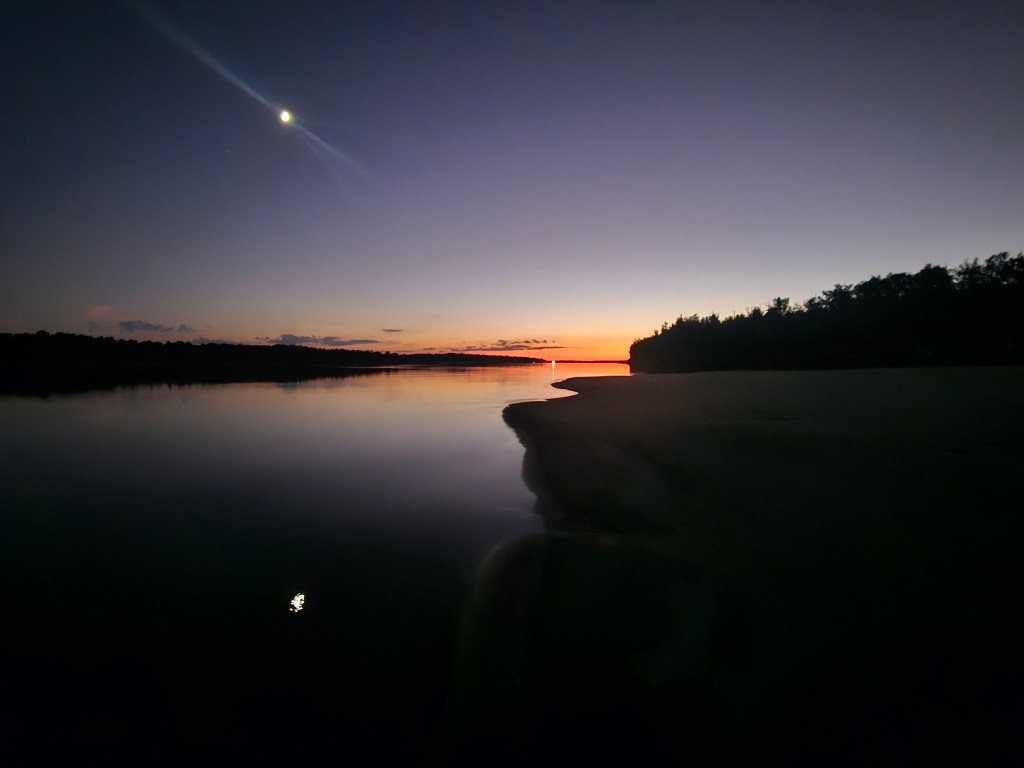
Other than my time in Memphis, my days have been filled with paddling from sunrise to close to sunset. The sandbars have been massive and plentiful, so no lack of great campsites. The weather has been pretty good, fairly hot during the day, not a ton of wind, and when I’ve had it, it’s been a tail wind, which is great. The nights have been calm, cool and sometimes a little breezy to provide an amazing atmosphere to sleep. Of course the sunrises and sunsets have been indescribable, and my pictures barely do them justice. I spend about an hour each night just staring up at the stars, watching the occasional plane go by and spotting satellites as they cruise across the heavens. The glow of one band of the milky way is ever present.

Today was the first day where I had a really sustained headwind, close to 20 to 25 miles per hour. So after hard paddling for eighteen miles this morning, the wind was only picking up. I picked the next sandbar island up ahead that had some trees to block the wind to stop. Plenty of time to set up camp and hunker down for the expected storms overnight. And plenty of firewood.

One of the reasons I’ve been putting in so many miles on this trip so far is to build in time for days like this. Better to put miles in the bank early and relax on the back end versus having to really rush towards the end. And when the weather is good, why not paddle the whole day?

For food, I’ve mostly been cooking some of my dehydrated meals I prepared ahead of time. But if there’s an opportunity to stop at a town and grab some food and cold drinks there, I won’t pass that up. Like yesterday in Helena Arkansas, I spent 1 – 3pm in an amazing barbecue place. I ate enough so that I didn’t have to eat dinner later.

The barge traffic has been constant, though I mostly paddle out of the main channel to avoid them and their wake. They rumble by at all hours of the night, but at this point, I can sleep right through the noise, and it’s kind of a feeling of comfort to have that presence. I think the biggest load i’ve seen yet is 48 barges with one tugboat. I hear myself mentioned as that kayaker coming down the river on the radio once in a while, and sometimes I chime in with where I will be, but mostly it’s listening to the captain’s chat back and forth with their incredible southern accents.

I’m used to traveling like this solo, so it’s pretty comfortable. At times I think it would be nice to have someone to peddle and camp with, but the advantage of doing it solo is that I can paddle when I want, and not paddle when I don’t. Every decision I make is mine and mine alone. I put on the occasional podcast, audiobook or playlist, but try to use those sparingly to conserve battery. Most of the time, it’s great just to be on the river with its natural sounds and scenes.

By my estimate, I have about 476 miles to the Gulf, and 12 days to do it in. There’s still some towns I want to stop and check out and hopefully some cool river people to meet. That should be quite doable if the weather and river cooperate.

mf

Taking a Break for the 24 Hours from Home Challenge

Back in July, I had the idea of this St. Louis to the Gulf paddling trip within the first minute of hearing I had been laid off. Pretty quickly, I knew the only big conflict I’d need to deal with was the 24 Hours from Home Challenge.

This event was something I started back in 2021 in the depths of Covid. A chance for my runner/hiker/adventure friends to take part in an event, not necessarily together, but competing towards a common goal of getting outside, covering miles and experiencing a heck of an adventure. In our sixth iteration of the event, I was in danger of missing it while out on the river.

As I dug into maps, mileage charts and trip planning, I had the thought of potentially taking a break from the river and somehow travelling back to St. Louis where the event is mainly based – though we have participants from all over the world. I don’t really need to be involved in the logistics or administering the race, as my friend Jon Marble has done amazing work with his app RaceOwl to allow participants to easily track their progress. I truly am in debted to Jon for his help with this, and the troubleshooting that goes on behind the scenes.

On Sunday of every challenge weekend, I’ve organized an awards and after party. Outdoors at a local park, participants who are local and able to make it come to celebrate their achievements. For many, these are some of the longest miles they’ve ever run/walked. It’s in incredible physical and mental challenge, and the stories people share from their adventures are often hard to believe. The Sunday of 24hfh every year might be my favorite day of the year, and I really didn’t want to miss it this year.

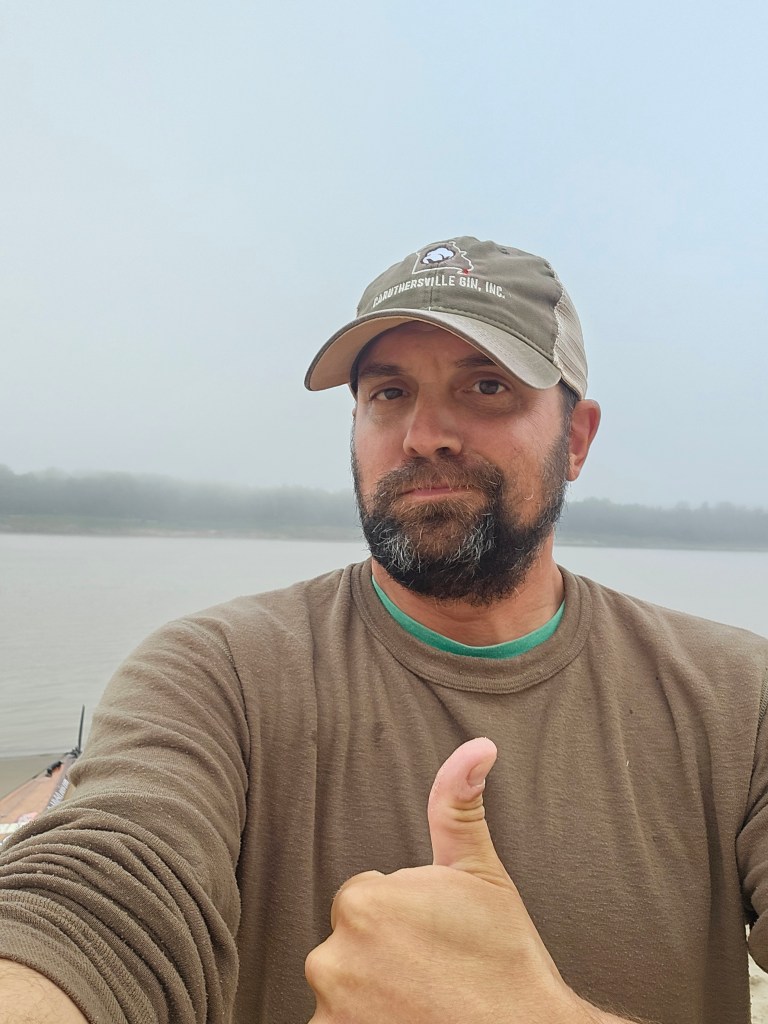
So after a few days of paddling on the Mississippi, it got a bit more clear where I could make a stop – potentially Caruthersville, MO. Then had to check if that stop had the right logistics for me to store my boat and gear, and arrange transportation home. I looked at Amtrak, Greyhound and UHaul, and even considered vagabonding by sticking my thumb out on the side of a highway. Luckily, I found an Enterprise rent a car in nearby Dyersburg, TN. I had the amazing assistance of Bob Pierce of Caruthersville Gin, Inc. to help me out with boat storage and a ride into Tennessee.

It’s all gone according to plan so far, I arrived back in St. Louis Friday afternoon. The first thing I did was take my first shower in 10 days – I highly recommend experiencing that feeling, if you can. Yesterday and today is a lot of logistics and errands, prepping for the big party tomorrow, cleaning up my river gear, charging batteries, stocking up my food supply, catching up with my wonderful and tolerant wife Sara, and cuddling with my kitties Omar and Kima.

I plan to soak up the positive and inspirational vibes at the party tomorrow and take that inspiration with me Monday morning, back down I-55 to Caruthersville and my waiting boat. Back on the river heading south.

mf

Rivertime – 9 Days Down

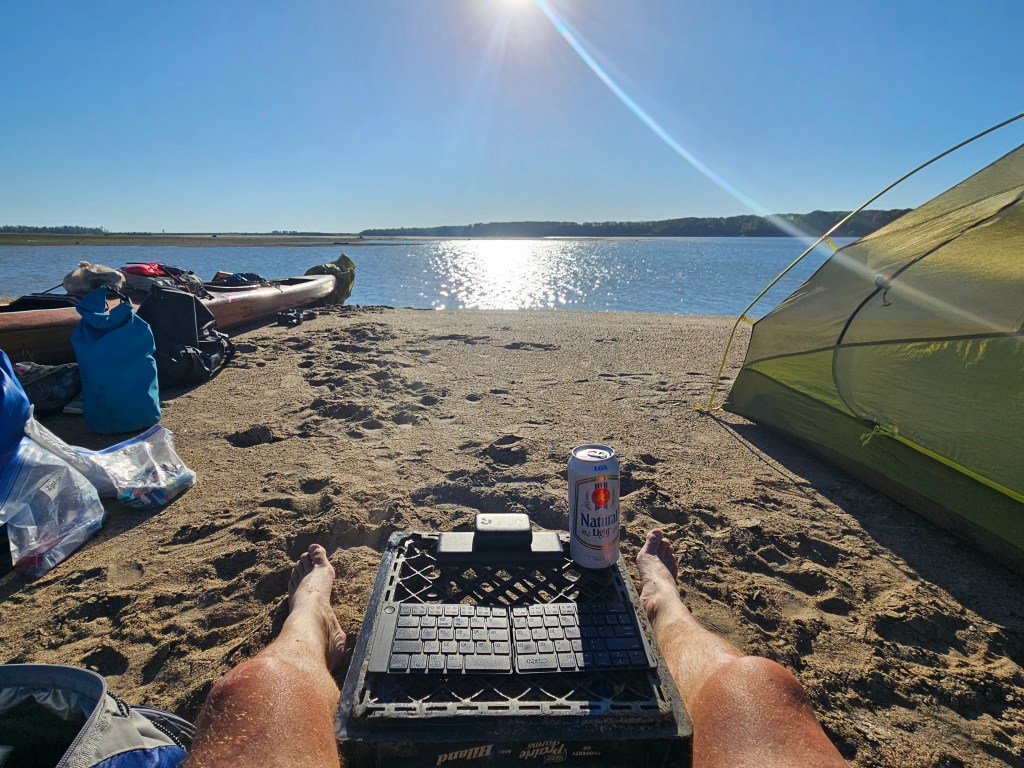
Sitting here on a massive island sandbar just above the city of Caruthersville, MO, cold beverage sitting on my crate table. Yep, 4th one of the trip. The first part of my journey has come to a close, 379 miles paddled or sailed over the course of 9 days. Tomorrow, I’ll paddle 3 miles down to Caruthersville, meet my friendly river angel Bob, who is going to store my boat and gear, then drive me into Dyersburg, TN, where I’ll get a rental car and drive back to St. Louis for the 24 Hours from Home Challenge. 

How I connected with Bob is a true illustration of the type of river magic that happens on a long trip like this. When I popped into Port Cape in Cape Girardeau, MO a few days ago, I started chatting with a friendly local named Jan. I told her what I was doing, and mentioned how I planned to get to Caruthersville to travel back home for the weekend. Before I was finished explaining, she was on her phone texting her friend Bob in Caruthersville. Within 2 minutes of meeting her, I had a river angel lined up 150 or so miles down the river. Magic. 

How’s the trip been so far, you ask? On the whole, delightful. Being on the downstream side of the Ohio these past few days has really opened my eyes to the scale and majesty of this river. The width, the endless bends and meanderings, the powerful yet seemingly silent creep of a tug pushing upwards of 40 barges by my tent in the middle of the night, the endless number of bald eagles I see day after day, the family of deer coming down to the water at sunset, the flocks of geese in formation on their way south, and the sandbars – my home for every night on this trip so far. It’s hard to tell where they start and stop, no doubt they are happy to be out in the sun rather than under 6 feet of muddy water. 

I knew the familar feeling of long distance paddling would return, I just didn’t know when. The daily cycle of waking up before the sun, religiously placing all gear in its appointed place in the boat, getting out on the water as the sun cracks the horizon. Getting the first hard paddle strokes in while I crack open my thermos of warm coffee. Whiling away the morning into early afternoon, picking out a nice sandbar on which to take a mid day stretch. Then looking at my maps downstream for where I might find an accommodating place to set up my tent. Pulling in and religiously setting up camp, cooking dinner, maybe have a fire, sip a little whiskey and read a little Mark Twain before falling asleep. That’s it, that’s all life is out here. The “real” world of big city life drifts away, and you’re on rivertime. 

Rivertime, that’s why we do it. Everything slows down. Distractions are few. I feel myself present in every moment. Feeling each paddle stroke, watching every tiny crest of a wave. Noticing the detail of every river bank or bend of a riverside tree branch in the wind. 

While paddling today, I put on a podcast – Dean Klinkenberg’s wonderful Mississippi Valley Traveler, where he interviewed author, artist, river guide and really a spiritual guru for me (who I intend and hope to meet further down river) – John Ruskey. Dean asked John – for those who aren’t able to get out on the river to experience it, how would you go about describing or conveying the feeling of travelling the big rivers? I sort of expected the answer to go in a different direction, when John replied, “You can’t.”

So after attempting to descibe it for you, rambling on an on, posting photos and video clips meant to capture bits and pieces, I’m gonna go ahead and agree with John. 

After the 24 Hour Challenge awards and wrap up party on Sunday, I’ll make my way back down to Caruthersville, enlist the help of Bob or some other river angels to get me back out on the river to continue the journey. Rivertime. 

mf

Two Days on the MO

Resting in some sweet air conditioned at home. An advantage of starting upstream of your home is to use your own place as a River Angel domecile on a big trip. Two days of paddling was enough to let me know what gear I might be missing, or what I don’t need at all. I was fairly spot on, only thing I need to procure is a bit more battery power.

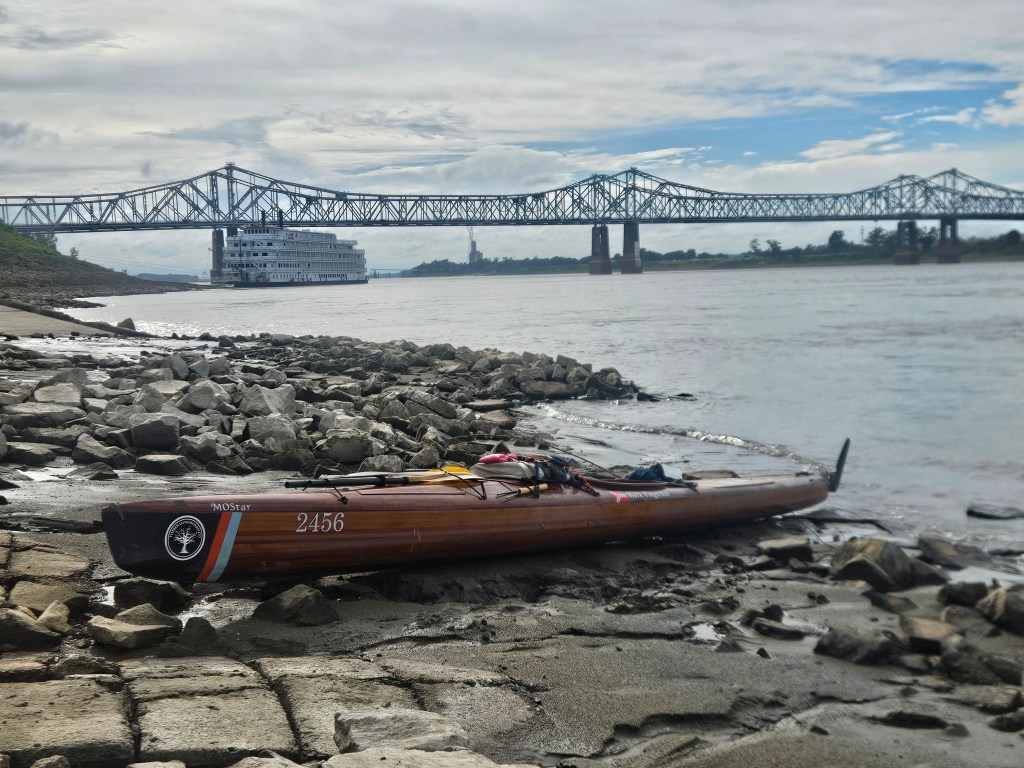
Left Paddle Stop Brewery in New Haven yesterday around 8:15am after a previous evening of boat cleaning and touch ups. I know, it’s a sin to let that work of art collect dust, but that’s the life of owning 8 or 9 boats, all of which have their purpose. And the Mostar, Shane’s hand-crafted masterpiece, is 100% perfect for expeditions. She performed well in the MR340, fully unloaded and sitting much higher in the water, but she really shines fully loaded, doing long days out on the big rivers. I forgot how amazing this boat was, but two solid days in it was enough to refresh my memory.

Five miles in, I got a call from Shane that I’d left my sleeping pad back in New Haven. Not to worry, Shane drove ten minutes to Dundee Bottoms, where he was able to meet me to hand it off. From there it was some pretty solid paddling, a quick stop on a sandbar across from St. Albans, then the slog into St. Charles. I passed under all the St. Chuck bridges around 5, feeling pretty gassed. I knew there was one more sandbar to consider before Pelican Island, which was my goal for the day. I decided to blow by the sandbar with an hour and a half left of sunlight and pulled onto the gravelly sand at Pelican around 6:45ish.

I set up camp in the waning light, and what a spectacular sunset it was – pics on IG – @paddlestlouis. A quick dinner over a blazing fire to keep the mosquitos at bay and I was snoozing by 9pm. Nice.

65 miles the first day was way ambitious, and not a distance I expect to keep up on the Mississippi, but that left a relatively easy 32 mile day today to get to the Arch and a ride back home. I got on the river at 7:18am under an absolutely insanse sunrise and liesurely paddled the last 17 miles of the Big Muddy MO. I completed the MO mid-morning then entered the Mississippi. I made my way under the very active Chain of Rocks bridge construction site and had to adjust my route for crossing work tows. I portaged the 200 yards river left of the Chain, churning and boiling and sure to chew up any wood craft to sawdust.

Made my way into the Port of St. Louis, and barge traffic was heavy. I have a short wave radio with which I can communicate with barges and had a chance to use it today.

Barge Captain to other Barge Captains: “We got a kayaker coming down out of the Old Chain of Rock Lock” (incorrect, I was not)

Me: “Kayaker here, I’m going to hug the right bank.”

Barge Captain: “Ok, thank you for having a radio.”

I did not carry a radio on the Missouri, as barge traffic is quite minimal. But it’s pretty much required gear on the much busier Mississippi. I’m sure this is the first of many interactions with my fellow captains on this trip.

Soon I was under the familar sight of the Eads Bridge then the Arch, and my good friend Bill welcoming me into the fishing ramp with a couple cold ones on a hot day. Super duper thanks to Shane for your craftmanship and running my sleeping pad down to Dundee, my sleep under the stars was spectacular. And to Bill your ever-present willingness to River Angel.

Plan is to get back in at the Arch tomorrow morning and get heading Southwards!

mf

A New Adventure: Trak Piloting

Back in the fall of 2024, I saw an email from Trak Kayaks. As a certified kayak instructor through the American Canoe Association (ACA), I was on their mailing list. I was familiar with the company, maker of high-end collapsible, packable sea kayaks. I had looked at their kayaks a few years ago, but didn’t really look too much deeper, with generally plenty of room to store my sometimes excessive boat collection. Space wasn’t a big issue, so I wasn’t too interested in adding a foldable boat to my fleet, especially at a premium price.

Anyway, Trak was looking to add Trak Pilots in select cities/regions. Trak Pilots are basically like product ambassadors, paddling veterans who become experts on Trak Kayaks, and offer test paddle opportunites and act as a quasi-sales rep for their boats. I opened the email, then clicked the link to see the list of locations. Scanning the list, it was almost all coastal cities around the globe, with a couple Great Lakes locations sprinkled in. But nothing near me, in St. Louis. In fact, no locations that were around big rivers. In the email was also a link to apply to become a Trak Pilot. I went ahead and filled out the form, maybe with a little midwest flyover attitude, explaining what a vibrant paddle community we have here at the confluence of the two longest rivers in the USA. I told them about our wonderful rivers, the big ones, the pristine Ozark streams and everything in between. I also told them about our paddling community, the racing, the expeditioners, whitewater and everything in between. I didn’t really expect to hear much after that, but was satisfied I stood up for midwest paddling!

A couple days later, Nolin Veillard, the Founder and Managing Director of Trak reached out, and we had a nice 45 minute phone call, him at the office in Vancouver, Canada and me walking the streets of my neighborhood. He asked about my experience, the paddling community and culture here in Missouri and what my future paddling plans and goals were. It went well, and he told me they’d be happy to include me in their consideration for future Trak Pilots. A few more emails and conversations with some Trak staff and I was invited to join as a Trak Pilot. What this entails is pretty wide open.

First, I had the opportunity to buy a brand new Trak 2.0 kayak at a steeply discounted rate. I’d be included as a Trak Pilot/point of contact on their web site. I’d be listed as the go to guy for people interested in Trak kayaks in the midwest/St. Louis/Missouri area. Then it’s pretty much up to me to make of it what I want. A few weeks ago, after a short hangup in customs, my Track kayak arrived on my doorstep.

The wife and I then left on a planned vacation to Vietnam and Thailand for a couple weeks. You don’t know me that well if you think I didn’t consider bringing my new boat along to paddle the incredible waterways of Southeast Asia. But alas, it would have added a certain level of logistics, not to mention some serious eye rolling from my wife that frankly I wasn’t prepared for. Ah well. Fast forward a couple weeks and a 65 degree Sunday offered my first opportunity to hit the water in the new boat.

I loaded my kayak in a bag into the back of my car and headed out to Chouteau Claim access, at the confluence of the Meramec and Bourbeuse Rivers. I got there a little earlier than my buddy Shane, so I had some time to unpack it for the first time and read the instructions on how to put together the boat.

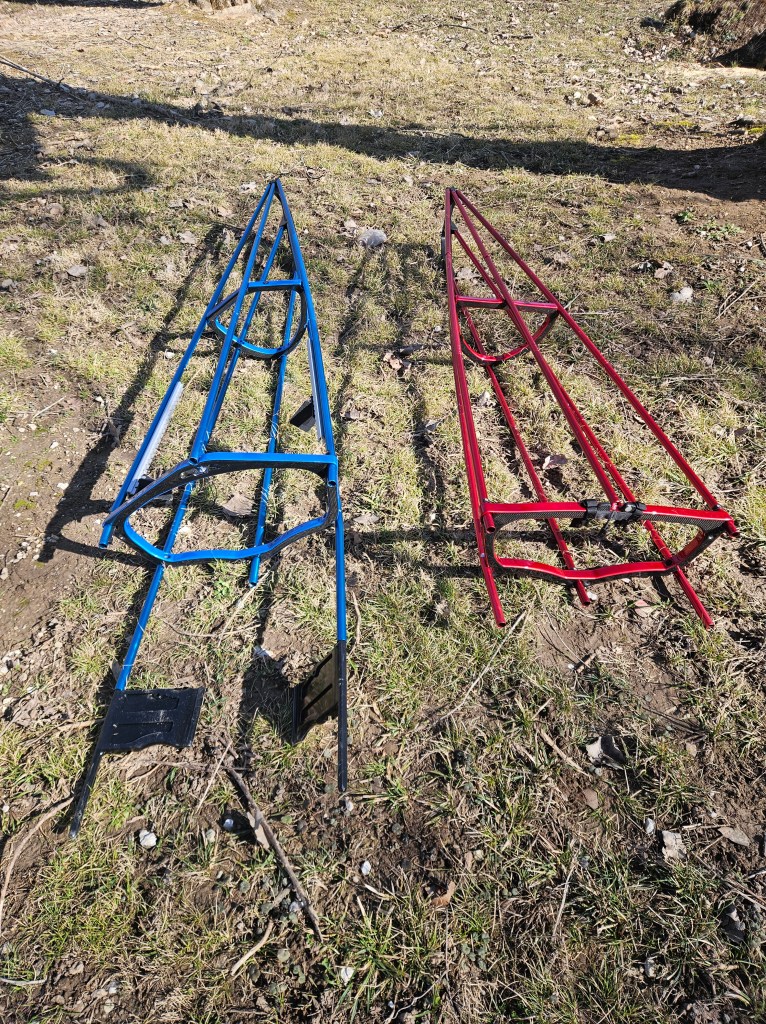
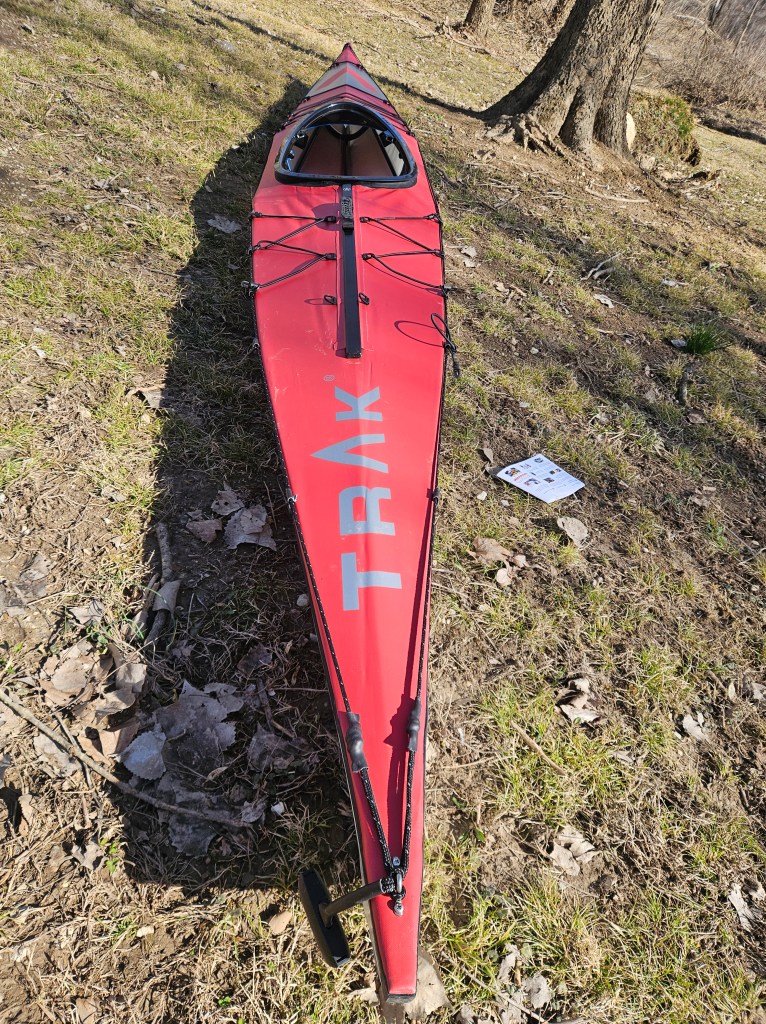
It took about 30 minutes, and that included some studying of the instructions and images, a few quick corrections, and a whole lot of learning of this technological wonder. It’s a skin-on-frame kayak, with an anodized aluminum frame, carbon fiber ribs and a polyurethane skin with three hydraulic jacks that add the needed rigidity. I managed to get it assembled just as Shane was arrving and unloading his SUP. It wasn’t too difficult at all, I have confidence I’ll be able to do it in the promised 10 minutes in the future.

Shane and I headed a few miles upstream on the Meramec, having to really power up some swift riffles, swing into some eddies for a breather, and navigate some shallow spots and submerged trees. We stopped on a sandbar to chat, then turned around and headed back downstream. At the Bourbeuse, we hooked a left a went upstream for a mile or two in the hardly noticeable current.

My first impression: this is a sweet boat. It’s only around 40 pounds, so is super light and glides across the water. It’s fast and responsive. There’s no rudder or skeg, but steering with paddle strokes and some leaning/bracing is super easy. Its draft is quite shallow and I glided across a few shallow spots and surprisingly didn’t drag. A couple spots I did drag, I felt fully confident the skin would hold up fine without any dings from rocks, logs or gravel. It did. The freeboard is minimal, so if I paddle this boat on choppier waters, I’ll certainly use a skirt.

I can’t wait to paddle this in varying conditions, and get it out on the Missouri and Mississippi. As the weather and water warms up, you’ll certainly see me out there cruising in this Trak 2.0. And if you want to take a look at the boat or take it for a test paddle, you know how to find me, just head to the river!

mf

2024 MR340 Race Recap

Missouri River 340, July 23 – 26, 2024

Result

#2341 – Paddle Stop New Haven – Dragon Boat

58:36:28, 89th place overall, 1st in Dragon Division

Team: Jessica Chase, Ken Costello, Sheral DeVaughn, Lee Doty, Mark Fingerhut, James Kipper, Kirstin McEvoy, Brandon Nolte, Brett Swanstrom, Joan Twillman, Betty Welch, Anqi Dai, Jackie Halloran

Support: Sherri Terun, Ron Twillman, Chris DeVaughn

Pre-Race/Prep

The origin of a 2024 Dragon boat run on the 340 started sometime last summer or fall, when my good buddy Shane at Paddle Stop New Haven mentioned he was thinking about building a new canoe. His first large canoe, the 24 ft Eliza Haycraft, competed with a crew of 10 in the 2021 340, in which I ran ground support. When he detailed out what he was thinking, an even bigger canoe with more capacity, my mind got moving pretty quickly.

For those not in the know, Shane is an artist when it comes to stand up boards, canoes, a single kayak, and other watercraft. I thought it was only right that if a new boat made its way into the world, the proper way to welcome it was a 340 mile race on the Missouri. Once Shane had a little more idea of the total capacity of the boat, I started recruiting.

However, I’ve found that before you ask someone to join this race in your boat, it’s pretty helpful to have an idea of what the experience is going to look like so they have all the facts. So a race result that looked like success to me was a competitive, thick-skinned and stubborn team, with the potential ability to nap/sleep in the boat since it was going to be huge, minimization of shore time and an ultimate ambitious goal of finishing in 50 to 55 hours.

I began with the 2021 Eliza crew and got the first 2 paddlers. Opened up the invite to my fellow Hash House Harriers, the drinking club with a running problem of which I am a practicing member and got a couple more. I then threw the invite out to the Creve Coeur Lake paddlers, a rowdy but competitive crew of STL locals, but didn’t find much interest there. Lastly, I posted an open invite on the MR340 page and was able to get near full capacity – a target of 14 heads in the boat. Fortunately, I had met and paddled with almost everyone in the boat, with the exception of 1 or 2.

In the months leading up to the race, I wanted to get the team (as many as possible) together for some practice/training runs. The way the roster worked out was a pretty even split of STL and KC-based paddlers with a couple from Oklahoma. In June, we gathered in New Haven then shuttled up to Mokane for a 40ish mile training run. The new dragon boat was still under construction, but we took the Eliza as a reasonable substitute. The day went very well. Paddling and speed was sufficient, but most importantly, the whole team met, got along, laughed and joked together and enjoyed the day. For a big group, many of who have never met, it’s hard to know what you’re going to get when the all get together. But my theory is anyone who would consider doing this thing called the MR340 has qualities and traits that allow them to get along with, and succeed with like-minded folks.

We did one more training run – which turned out to be the Meramec Marathon, a 29 mile run on the Meramec River outside St. Louis. We happened to be the very first dragon boat to ever compete in this race. We had the new, yet-to-be-named boat, and despite Shane’s concerns of low water conditions and risk of scraping the virgin cedar wood, all was good. The rudder allowed me as captain to line up the boat around sharp turns and bends, as well as shouting commands to the team to paddle on a particular side. I don’t believe we touched a rock that entire race and I was super happy with the boat, and the team once again. We were ready for the big race!

The last couple weeks leading up to the race was fairly harrowing in terms of personnel. We had 13 committed, I was happy with that, we could fit one more, but good enough. We lost one paddler after the Meramec race, so I reopened the call on the MR340 page. I was able to add 2 paddlers so back to a full 14!

Four days before the race, we lose 2 more. Oh crap. I was able to find one last paddler who registered two days before the race so we were back to a solid 13. I was quickly realizing that for a Dragon team, the hardest part of the race happens before one gets to the starting line. The rest is easy!

The Race

Most of the team gathered at Kaw Point for race check in, and we got the newly named boat “Twelve Volt Man” in the water and tied up. We did some team shopping then divided our gear and support needs among 3 support vehicles. Each vehicle was responsible for supporting 4 or 5 specific paddlers, just to avoid the chaos of having gear and items spread out all willy nilly.

I don’t have to mention how chaotic the pre-start was, try coordinating getting a team of 13, plus gear/supplies, plus 3 support vehicles to the start. Finally at about 7:30am, the team was gathered near the ramp. I asked some spectators by the river to move along so our team could stage, while I hopped in the boat and nosed it toward the ramp. Obviously, the ramp was a constant conga of boats getting into the water. Seeing a small gap after the Krakamaran got in, I aligned the front quarter of the boat on the bottom half of the ramp, then just started having the team throw me all their gear, loading back to front. I think we were fairly efficient, and we soon had everyone in and gear mostly situated.

With a few minutes to spare before the start, we leisurely drifted upstream, and I wished many of my friends good luck. My strategy at the start is to be as far left as possible and enter the Missouri at the very tip of the point. I want to always be the boat furthest left possible, not sure why, I think it’s about getting into the current as fast as possible. A couple unfortunate canoes managed to get to our left and began drifting right, into our path. We tried to announce our presence, but 3500 pounds vs. a couple hundred is no contest. We bumped and pushed them away like bugs off a windshield.

We settled into steady paddling, probably in the top third of the 8am starters. For spectators in the early part of the race, and then throughout, the spectacle of seeing the only dragon boat in the race is pretty special and we were rewarded time and again with hollers, cowbells, horns and other undulations.

Our race strategy going in, which I made sure to communicate early and often to potential and confirmed teammates was as such.

First day: quick stop at Waverly, (optional) quick stop at Miami, late night arrival in Glasgow. 2 or 3 hour shore time.

Second day: quick stop at Franklin, quick stop at Jeff City, arrival in Chamois. 2 or 3 hour shore time

Third day: quick stops if/where needed, finish late afternoon.

After our second training run, I realized having people recline/sleep in the boat was not really going to be possible. So minimal shore time, but with the ability to get a couple hours sleep was the plan.

The first day proved to be pretty spectacular weather, not insanely hot, a little breeze but not enough to affect our pace. The team was in good spirits, staying hydrated and fed, getting to know each other a bit better with lively conversation and jokes. And of course having a constant supply of fellow boaters overtaking us, or us overtaking them, made for endless opportunities to meet new people, and have them take in the spectacle that is the dragon experience.

We bypassed Lexington as planned and pulled into Waverly around 5:30, spent about 20 minutes resupplying food and water, bathrooms, etc. A note about our hydration: I left hydration up to each person – some hade camelbaks, some had bottles, then we had two 4 gallon jugs of ice water that we used to refill our personal supplies over the trip.

The team felt good and we made the decision to bypass Miami to push on to Glasgow. We all enjoyed the sunset and moonrise, as well as the occasional riverside party of locals there to cheer on our roving party. For seating arrangements, I generally left it to the team to figure out what works best for them. I am not a micromanaging captain. Occasionally, seat partners would switch sides to change the muscles they were paddling with, announcing their switch to the boat due to very short moments of instability. The other amazing advantage to this boat was for paddlers to stand up occasionally to stretch their legs and get a quick moment on their feet. As the captain, I was standing quite often, getting a better view of what’s coming. With a longer paddle, I was able to paddle while standing up, which was so nice.

Pulling into Glasgow just before 3:30am, I told the team I was going to wake up at 6 and if there was no fog, I’d rouse them and we’d get going. Our wonderful support had a few tarps laid out on the ground near the ramp, and we all quickly crashed out with our respective sleeping systems. I think I only manage to get a little over an hour of sleep. At 6, downstream of Glasgow looked like a pretty solid wall of fog, but I started waking up the team, through not at an urgent pace. I started shaking a sleeping, covered body within our team circle, only to have a face I didn’t know looking back at me. An interloper in our midst, sorry about that unknown paddler!

On the water by 7:30, the fog had all but lifted and we were quickly into Lisbon Bottoms. As a 7 timer in this race, I took the opportunity (wanted or not) to regale the team with previous race stories throughout the race, including the time a pair of sombrero’d gentleman managed to pin their canoe getting too close to the Lisbon chute and luckily survived that ordeal.

It really started heating up quickly, hotter than day 1. I encouraged the team to drink plenty, and pour river water over their heads, necks and torsos. As we approached Franklin Island, which we had planned to bypass, from the front of the boat I heard the last-minute request to stop. We pulled in and found out that Betty was feeling down. We helped her off the boat and into the shade to sit, and luckily she had a couple friends nearby to help her. In the meantime, the team took the time to grab a baked potato, and jump in the water to cool off. Betty was insistent that we keep moving without her, and I was insistent that we would wait, allow her to cool off and get back in once she felt better. After 10 minutes of not really solving anything, I made the decision that we’d proceed without Betty and she insisted that’s what she wanted, and she was good with it. Whatever time/place goals we had as a team was never as important as team health and finishing with a full crew, and I hope that wasn’t missed when I laid out our plans in the race leadup.

Betty and Jackie were two of our later additions to the boat, and have some pretty solid dragon boat experience. So I was super happy to have them, and they were valuable and stout additions to the team. But wearing only tank tops and no hats all day, exposed to the unrelenting sun, I just don’t get it! Wow. But Betty was truly one of our strongest paddlers in the boat and she was the MVP of our first 1.5 days out there.

We paddled on with 12, somewhat sluggishly to Rocheport, the gorgeous bluffs and the new bridge, harassing a couple workers as we passed. We planned to push straight to Jeff City, but taking inventory of our water, we decided to pull into Huntsdale to get a quick refill of our jugs. Big thanks to Huntsdale staff and random support crews for helping us out. Shortly after Huntsdale is where yours truly started to bonk. It was the lack of sleep that was catching up to me. I felt hydrated enough, I was peeing regularly, I didn’t feel overly hot and was eating enough. Just foggy mind, inability to keep my eyes open and extremely heavy limbs. I struggled to paddle and just concentrated on working the rudder pedals to keep us in the channel.

With 5 miles to go to Jeff City, I felt I was in danger of slumping over, so I grabbed our one of two 340 virgins, Brandon, and threw him in the captain chair. I gave him the general concept on where to keep the boat, then I closed my eyes for about 10 minutes. I woke up closed to the ramp and guided him on the line to take, cutting over at the last minute and hitting the big eddy. I get off the boat, up the beach and collapsed on a waiting tarp.

After about 20 minutes of struggling to sleep, I saw my friend Josh, who was operating the Morpheus mobile IV clinic during the race. I told him what was going on and he recommended a B12 shot. I took him up on it, looking for anything to help perk me up for the push to Chamois. The team took the opportunity to eat, refuel and a couple laid down for a quick nap. After about an hour, we got back in the boat to Chamois. My body started responding better, but felt my mind was still operating at about 60% capacity. I turned on the RaceOwl channel tracking app, which I have never used in my previous races, to basically allow my mind to solely focus on the small screen and keeping our boat lined up. I pushed myself to participate in various conversations on the boat to also keep my mind working and occupied. After about 3 hours, I felt I had full mind and body capacity once again. We hit Chamois at 12:30am.

We once again crashed on tarps under the nearby pavilion, folks ate, drank, a few showered then slumbered. I woke at 4:30am to assess the fog. While thick, I could see the opposite bank, so I started waking the team. For the second day in a row, I mistakenly woke up someone sleeping near our group that was not in fact, in our group. Hazards of being a dragon boat skipper #922. This time, though, he thanked me that I had gotten him up!

On the water at 5:30am, we quickly encountered the thickest fog of the race. Mr. Jon Marble saved our bacon once again, and I ran the channel tracker though about 4 hours of fog to Hermann. As a pretty experienced river guy, I understand the risk and the dangers of fog. I also take my responsibility as the leader of a team of 13 very seriously. Their safety and well being ultimately in my hands. So it was a calculated risk to paddle through the fog. I was aware of where the barges were (nowhere near us) and was pretty familiar with the stretch of river. I heard the lighted and rumbling water outlet for the Callaway nuclear plant on the river just down from Chamois. I know that did scare other paddlers who encountered that in the fog, and made them deviate their plan thinking it was a barge, but I knew exactly what it was and kept to the plan. Familiarity with the river and its features is something I take pride in and have acquired over many years and miles.

The fog saved us from seeing the Hermann bridge for 8 straight miles and we hooted and hollered at the early morning Hermann crowd as we passed. We made quick work of Berger Bend and reached our craft’s port of call in New Haven. A quick refueling stop and greeting from our boatmaker Shane had us primed for the home stretch. We blew by Washington at 1pm and planned to push all the way to the finish, the only exception being Klondike, but only if they had Klondike bars. Alas it wasn’t to be. Just past Klondike we heard distant thunder, some light drizzle, 2 barges with requisite wake, and a little headwind. We were loving every second of the changing conditions. Adrenaline was in full affect and we could smell the finish.

Sprits remained high, and we distracted ourselves with trash pickup! From a standing position, I’d survey the river ahead. If I spotted what was likely a piece of trash, I’d get us in line with it, then the first two rows of the boat would grab it and deposit into our stream team bags. Between our own trash and what we pulled out of the river, we filled two bags per day, six total! (Most interesting piece of garbage – a Ziploc bag of urine. Undetermined if it originated with a 340 participant.)

Coming under the second to last bridge, we were distracted by two friends of a few of us in the boat who cheered us on in varying stages of undress from up on the shore. We didn’t begin our finishing sprint until well after the final bridge, I would have preferred to start earlier, but the team was near spent. We kicked it in to the finish, unbeknownst to us a drone captured our final looping sprint in.

Instant chaos on shore, medals, trophies, beers, the team scatters, hugs and photos, the usual post-race high. Still had the task for finding a place to tie up our trusty craft on the shore, and the thigh deep mud I missed throughout the race was there to greet me as I tied him up.

In Closing

My first dragon experience was just incredible. I’ve done this race tandem 4x, solo 2x, and now dragon. The added element of team camaraderie, the laughing and singing, conversation and interactivity during the race nearly outweighs the logistics of organizing all aspects of the team and herding the cats. Don’t get me wrong, this was a great group of people, extremely solid paddlers and go with the flow/adapt and overcome personalities. Time will tell if I ever undertake such an endeavor again, but this was a truly special experience.

Massive thank you to the entire team who took a chance to be a part of a special experience. And to our support/ground crew – thanks for being there for us, putting up with our whims and for being absolutely flexible, when it wasn’t hard to do so.

Massive thank you to Missouri River Relief, all the staff and volunteers without whom this would never be possible, Scott Mansker for dreaming this up, to all my fellow paddlers and support who took a minute to say hi along the way. I absolutely love this river community, and this week always fills my soul.

Thanks for reading, see you on the river.

mf