February Update

February in St. Louis usually means lots of time spent indoors, out of the cold, snow, ice and general bleakness of winter in the midwest. Last weekend was unseasonably warm and did afford the opportunity for a nice paddle on the Big River and Meramec, from Byrnseville down to Route 66 State Park. Yesterday the thermometer barely touched freezing, but I had the chance to explore the beautiful sandstone canyons and frozen waterfalls of Don Robinson State Park with some friends.

Preparation for the trip is ongoing. I am officially approved for a sabbatical from my job. After approaching my boss with the idea for the trip, it was run up the ladder to my VP, HR then eventually the CEO and consideration was tendered, approval was given. It took a week or two to work out the details but this past week I was able to make it official, as much as publishing a post on social media counts for offialdom. As Norm Miller commented on my post, I have to do it now.

I didn’t expect fundraising for Missouri River Relief to kick off this early in my prep, but I went ahead and added the fundraising option to my initial Facebook post and have generously recieved just over $400 in donations. I am very grateful to all those who’ve contributed.

The kickoff barbeque and paddle day on Sunday, April 28th is the next big task. The invites are out, but now to find sponsors for food, drink and raffles. I don’t think there will be any shortage of boats and boards for people to try out, but I do have a concern about having enough PFDs to go around. Plus the end of April in St. Louis is certainly a wild card weather-wise. We’ll at least have a pavillion for shelter if needed.

One of the biggest logistical puzzles to solve for the trip will be supplying my body with enough calories and nutrients to fuel about 6 days a week of 8 to 10 hours of paddling. Late last year, Sara encouraged me to look into food dehyration. She follows a few food dehyration subreddits and ordered me a fantastic book detailing methods, ideas and recipes. Since the new year, I’ve really gotten into it. It probably warrants a separate post to detail out all that I’ve made, but suffice it to say, I’ve been dehydrating something almost every day and have been assembling meals to freeze now, and consume somewhere along the Missouri River this summer.

Hopefully over the next 6 weeks or so, a key component to my trip’s success will be procured. My friend Shane of Timber Longboard Co. will be crafting me a new kayak. While he has made some amazingly beautiful and functional stand-up paddleboards, this kayak will be his first. I have little doubt the he will make a top-notch boat. I am hoping he will complete it with ample time for me to try it out, to get comfortable with it, and to ensure it will be able to get me down 2400 miles of big muddy water. There is however, a backup plan in place should things not go according to plan with the new boat.

Others have already asked me, and have made tentative plans to meet me at certain points on the river. I am grateful to those who will make the journey, whether that be to Montana, the Dakotas, Omaha or much closer to home. I am certain that seeing familiar faces along the way will lift my spirits and keep me going. I hope to polish up a rough itinerary in the next few weeks which I’ll share.

Work is very busy and will contunue to be until my departure in mid-May. I don’t think the reality has set in quite yet, for either myself or coworkers, in terms of roles and responsibilities when I am out. I put together a rough plan, but it will certainly need to be more detailed and I’ll need to prepare those who are assuming my responsibilites to be successful with me out.

mf
Missouri River Relief

So Mark, what is this Missouri River Relief you talk about? What do they do? Why do you want to raise money for them? Why not pick another cause? What’s your experience with them?

I wouldn’t consider myself a life-long river rat. Sure, I filled sandbags in Bellefontaine Neighbors during the flood of ’93. I stared at the massive Mississippi and Missouri Rivers on outings as a kid, wondering where the rivers started and ended. I scrambled down into the pungent River Des Peres during my dad’s softball games at Wilmore Park. Like many St. Louisans, I went on the yearly southern Missouri ‘float’ trips. But in 2010, when I signed up for my first MR340 paddle race, I really began to see our local rivers differently. I got to spend hours on these massive rivers in a tiny boat, learning the currents, watching the eddies and whirlpools, seeing the wildlife on shore, flying above or jumping from the water in front of me…being in such a wide open space that I didn’t often get to experience growing up in a crowded city. I fell in love with being on the rivers and knew this would become a big part of my life. And not to keep these treasures to myself, but to share them with others, and to protect them so everyone who comes after me can experience what I have.

Enter Missouri River Relief:

Missouri River Relief is a community, volunteer and equipment-based not-for-profit organization dedicated to connecting people to the Missouri River through hands-on river clean-ups, education events and stewardship activities.

https://www.riverrelief.org/about/

I heard about Missouri River Relief in 2010 as a first timer in the MR340. MRR is a huge sponsor of the race every year and provides boats, volunteers, safety resources and general river knowledge and expertise to the ever-growing race. I got to know the organization and various people involved in MRR over the past few years. I’ve continued to participate in the fun stuff – the races put on or sponsored by MRR, but I’ve also gotten out to their river cleanup days, as well as speaking & community events that MRR plays a big part in.

In addition to the above, MRR is very involved in education around the river. They train teachers on how they can integrate the Missouri River into their classrooms and lessons. They run a program that takes every single 4th grader in the Columbia, MO public school system out on the river for a half day – Amazing! They also partner with many other education focused community and conservation organizations and events.

Right there smack dab in the middle of that mission statement up there is what I most value about MRR: connecting people to the Missouri River. If I can undertake a massive adventure like this, but also bring more eyes to the river and Missouri River Relief more specifically, that’s a wonderful opportunity. Steve Schnarr, MRR’s Executive Director has been great in providing me information and resources and I look forward to MRR’s support throughout my trip.

I have a link on the right side of this page where you can make a donation to Missouri River Relief – anything you care to contribute is much appreciated. But also consider other ways you can get involved: come on out to a river cleanup day – they are really fun and a pretty awesome way to have an adventure on the river – and they are super kid-friendly. Consider paddling on the rivers – Race to the Dome, or if you’re more ambitious the big one – 340 miles from Kansas City to St. Charles. Or talk to me or other river rats – it’s not as hard as you think to get out and paddle for fun on our rivers. Or just feel free to follow me along on my trip to be a part of the experience. Thanks for reading!

mf

PS – throw them a like on the Facebook or Instagram:

A Trip by the Numbers

mo river

From the edge of Yellowstone National Park to the foot of the St. Louis Gateway Arch:

  • States (7): Montana, North Dakota, South Dakota, Nebraska, Iowa, Kansas, Missouri (Wyoming??? Illinois???)
  • Total miles: 2,450
    • Madison River: 100
    • Missouri River: 2,341
    • Mississippi River: 9
  • Number of dams: 15
  • Average depth: 10 to 20 ft, at least 6ft at low water
  • Average current speed: 1.2 to 3 miles per hour, zero mph on the lakes
  • 3 of 5 of America’s largest reservoirs: Lake Sakakawea, Lake Oahe, Fort Peck Lake
  • Total number of days from start to finish: 90 to 140

mf

Can You Canoe?

In talking about my trip with a friend recently, I explained how it was difficult in trying to explain to kids (and some adults, too) exactly what I’d be doing during my MO River descent.  He told me about these fantastic artists, the Okee Dokee Brothers. They created a full album about paddling on the Mississippi River, appropriately written and performed during their Itasca to St. Louis trip in 2011. His kids love it and it really introduced them to the river and the poeple who are crazy enough to paddle it. Fantastic!

One Step Closer…

Heavy snow is falling late this Friday afternoon. It promises to keep up until tomorrow night. It is a very good day. Today brought me one step closer to making this trip a reality. I notified my boss at work that I’d like to ask for a sabbatical. I explained what I am planning on doing and of course had to answer a lot of the basic questions. She let our VP and HR rep know and it seems to have gone over ok. Now I’ll wait for the gears of officialdom to grind, then hopefully get approved and start working out the details of the sabbatical itself, the plan for my absence and what I can expect to come back to.

In the meantime, here is me at Three Forks, MT. The start of the Missouri River. The Jefferson River is behind me, the Madison River to my right. I’ll be starting about 100 miles upstream of here on the Madison. Sara and I stopped at Three Forks during our honeymoon in October 2017. At the time I knew I’d be back there, I just didn’t know it would be this soon.

mf-threeforks

mf

The Trip: The Why

There will be ample opportunity and time to explain the How of this trip. Planning, logistics, preparation: I can (and will) write for hours about what I’ve already done and what I will continue to do leading up to departure in May. What’s more difficult to put down on paper are the reasons I’ve chosen to do this trip.

As I’ve had the opportunity to try to explain what I am planning on doing to curious friends and family over the recent holidays, I have a decent grasp on what my motivations for this trip are. First and foremost is the adventure and the challenge. I’ve tested myself on the MR340 a handful of times. Every time I finish that race, I tell myself that’s the hardest thing I have ever done and will likely ever do. By undertaking the MR2450, I am changing that realization. I believe this will be the hardest thing I have ever done, and will ever do (until my next idea, I suppose…) The planning that I’ve done has already been challenging and very educational, as I’m certain the next few months will be. And when my loaded up car pulls out of the driveway in mid-May, it will be time to test my planning skills, my ability to deal with challenges that arise and my day-to-day capacity to just survive. Physically and mentally, it will be totally different from anything I’ve done before and I expect to learn much more about myself and the world in the process.

My secondary motivation is not quite as selfish. I’ve learned that many people who’ve previously undertaken a Missouri River descent trip have done so in an effort to raise money for various noble causes. The attention and publicity a long distance paddler will inevitably receive from not only friends and family, but from local media along the way and of course the ever-expanding reach of social media is a wonderful opportunity to do something great. I’ve decided to raise money for an amazing organization, Missouri River Relief. The first line of their mission statement is something that has been on the forefront of my mind since before my first experience on the river and will certainly remain a focal point in my life for the foreseeable future:

Missouri River Relief is a community, volunteer and equipment-based not-for-profit organization dedicated to connecting people to the Missouri River through hands-on river clean-ups, education events and stewardship activities.

Certainly, I plan to expand on what this organization does and what they mean to me, and why I’ve chosen them as the source of any fundraising I am fortunate enough to undertake.

In my personal and professional life, I feel like I am in an ideal spot to take this trip this year. My ever-patient and understanding wife is up for this adventure as well. She’s helped me plan, work through ideas, acted as my reality check and will be my virtual ground crew during the trip. She will travel to Montana to push my boat into the water and will be my eyes and ears back in base camp here in St. Louis during the trip. And she might even come meet me somewhere along the way. My employer will know about my plans soon enough. I’ve been a loyal and effective employee for 13+ years, and I am crossing my fingers that my proposal for a sabbatical will encounter understanding, flexibility and encouragement from them. To be continued…

Thanks for taking a moment to read and hope you’ll continue with me on this adventure.

mf

The Trip

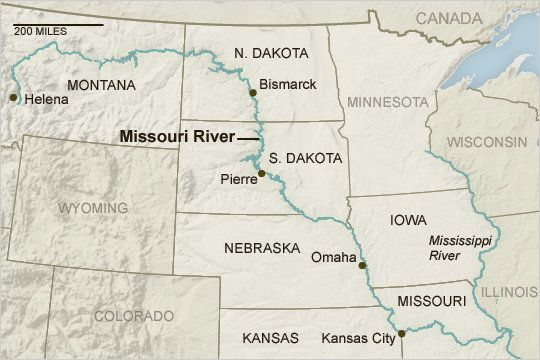
The Missouri River: from the confluence at the Mississippi River in North St. Louis County, 2,341 miles upstream to Three Forks, Montana. The Jefferson, Madison and Gallatin Rivers come together within a half mile of eachother and create a clear, cool, calm flowing river.

My experience on the Missouri began in Cousin Hugo’s Bar in early 2010. Until the time, the Missouri was there. It was something to look at from the bridge, or to look out at from the safety of a wooded bank or levee. In Cousin Hugo’s that night, I learned that a fellow runner in our local group was going to participate in the Missouri River 340, a 340 mile paddle race from Kansas City, MO to St. Charles, MO – taking place that July. Charlie’s first attept at the race at a time he was 68 years old*, had his loyal friend Dan worrying about him surviving the race, much less finishing. Dan suggested I join Charlie for the race. A few beers deep after that day’s run, I was in!

8+ years and 4 MR340 finishes later, I’ve come to love the Missouri River and have set my sights on something bigger: to paddle the entirety of the river (plus a little more). I want to put my name on the relatively short list of those who have done it. I want to explore the bends, the coves, the rapids, the portages, the windswept lakes of the unfamiliar upper Missouri. I want to approach Kansas City from the upstream side, then finish with the now familiar 340 miles to St. Charles. Then I’ll paddle 26 more miles to the Confluence, then 9 more miles to the St. Louis Gateway Arch, the finish line. Oh, and I am going to start the trip on the Madison River, 100 miles upstream from Three Forks where it flows out of Yellowstone Park, a couple miles from Old Faithful. 2,450 miles.

The plan is to start in mid-May 2019 and finish sometime in September.

I always thought the MR340 was the hardest thing I’ve ever done, and likely the hardest thing I will ever do. I no longer think that. Over the next few months, I hope to provide a peek into the planning and preparation I am undertaking, the amazing people and groups that are already helping me towards my goal. Then during the trip, I plan to share experiences, images, video and my progress towards the finish. I’d be honored if you would join me.

*Charlie is planning on participating in the 2019 MR340, at age 76, paddling with his son and grandsons!

mf

Bourbeuse River – Hwy 44 to Guth’s Mill Dam

A completely free birthday eve Saturday greeted me yesterday so I tossed around familiar bodies of water to hit. A Washington, MO based co-worker has always told me about his float trips on the Bourbeuse River and a quick Google map search revealed an easily accessible river access just off Hwy 44 near Union, MO – Uhlemeyer Access.

I loaded my Eddyline Nighthawk 16′ up on the car and headed out. I was tempted to take one of my new to me beater kayaks I just got last weekend, but although shorter, their weight is somewhat prohibitive for a single person trying to load them on the car.

I dropped in at Uhlemeyer (river mile 102.3) around noon and headed upstream. Quickly passing under the 44/50/66 bridges, the water was calm and glassy, with almost no current to paddle against. I passed a kayak fisherman and a john boat with guys busy baiting hooks. A little further upstream, a flotilla of short kayaks sat on a sandbar while a family group swam in the water nearby. A cool cloudy day produced a little bit of drizzle for about 30 minutes, but then the sun came out for the remainder of the paddle. Continuing upstream, I passed under a train bridge, with quite a few river shacks on both sides of the river.

I had Dan Carlin’s Hardcore History podcast going – Supernova in the East I – about Japan’s historical rise and cultural lead up to WW2. Amazingly interesting soundtrack to accompany the beautiful sights on the river. I didn’t really have a turnaround point in mind, but a little further up, Google maps indicated the river running right behind a Wal-Mart, so that contrast of the natural and the consumerist acted as my unofficial goal. After a leisurely three hours and multiple points of having to get out and drag the boat due to shallow riffles, I spotted a big concrete structure stretching across the river. Getting close, it looked like an old mill and associated dam. This is Guth’s Mill Dam (river mile 96.8). I opted not to portage, spent a few minutes climbing up on the dam and checking things out. Wal-Mart-upon-Bourbeuse would have to wait for another day.

The paddle back downstream went fairly quickly and I was back to Uhlemeyer by 5pm. Overall, the Bourbeuse at this stage was pretty shallow, having had to drag the boat in a few spots. But this stretch is perfect for an easy day out on a surprisingly clean river. At one point, in a huge driftwood pile on the side of the river, I spotted the nose of an aluminum canoe that had been swept up in some past deluge. So I may have occasion to hit this stretch again in the near future to see if a salvage operation may be feasible.

37878724_10160911440155107_2155937079941398528_o

Non-Motor Watercraft Buying Guide for the Midwestern Novice

So you’re gonna buy a boat huh? I applaud you for your excellent choice in how to spend your limited leisure time. For residents of the St. Louis Metro area/Midwest region, there are an unbelievable number of rivers and waterways to get out and enjoy. I am very excited to see an increased interest in getting on the water in our area and look forward to paddling with all of you in the near future.

This is my attempt to share some advice on what kind of watercraft to select based on my very limited knowledge and experiences on the water.

When people ask me what kind of boat they should get, my immediate response is to answer their question with a question: what are you looking to do with it? What’s your ideal vision of a good time out on the water? Hitting class 5 whitewater? (Not a lot of those around here, but good luck!) Multi-day/night paddles on the pristine clear streams in southern MO? Setting speed records on the big rivers and becoming a MR340 legend? Taking a leisurely cruise down the River Des Peres with the Brown Water Navy while avoiding discarded syringes and stinky tennis balls? Whatever your pleasure, there’s a boat for that!

Stand Up Paddleboard (SUP)

I am not an expert in this category and have only SUPped for about 5 minutes total in my life. If you are interested in this, please contact one of the two local SUP experts, both named Shane for your convenience. (Timber Longboard Co. | SUP St. Louis)

From my view, if you like standing up, looking fish in the eye, like a full body workout more than a sit-in boat provides, and you are a minimalist who doesn’t need to bring a lot of gear when you’re out on the water, then a SUP might be for you.

Canoe

You’ve all been in one at some point in your life so you know what you’re getting. Big heavy aluminum battleships are perfect for rocky rivers, stuffing full of beer and camping gear and going on a leisurely multi-day paddle. But they’re a bitch to lift, haul and portage.

The Cadillac of canoes are Wenonah in my opinion. Many of them come in Kevlar or carbon fiber – super light, fast, stable boats, but you’ll pay for it. If you do opt for the Kevlar or Carbon Fiber, you’re going to want to steer clear of any bodies of water where you have a chance of hitting rocks, logs, small children or other obstructions.

You also can’t go wrong with Mad River or Old Town brand canoes. Most canoes you find are going to be tandem (or three seaters), but you can also find solos here or there.

(I currently own a Wenonah v1 Jensen, which is a custom built canoe I was lucky enough to acquire second hand. It is 18’6”, weighs about 30 pounds and is Carbon Fiber. A comparable boat retails for $3 – $4k, but if you are lucky enough to come across a used one, can get them for between $1 – $2k. It is super light, fast (when you have two finely tuned engines) and is very unstable for beginners. It takes a lot of hours in the saddle to get used to. I’ve used this boat on two different MR340s, countless runs on the local big rivers and even (unadvisedly) on some rocky stream trips in Southern MO and Kentucky. I did add Kevlar skid plates on front and back so I don’t cringe every time I pull up to a concrete boat ramp.)

Kayak

My most recent obsession so this is the category I have the most knowledge on. After many years paddling a single blade and striving to find the perfect canoe stroke to keep the boat pointing to where you want, I gave up and joined Team Kayak. With a longer kayak, it is much easier to steer where you want, to move down the river on the most efficient line, and (to me) have a generally more enjoyable experience. You don’t have to worry about learning any complex paddle strokes or counting strokes/transitioning from one side to the other/trying to stay in sync with your idiot canoe partner.

My first boat was a Dick’s sporting goods special – a 10’ Perception sit inside kayak. The shorter the kayak is, the more effect each stroke has on the direction of your boat. You paddle right, the boat goes left, you paddle left, the boat goes right. This effect is magnified the shorter your boat is. You can count on a lot more zig zagging with a 10 of 12 foot boat than a 14 or 16 footer. Short boats are great for small streams, short trips on lakes, or general fun on the water for an hour or two. Anything beyond that and you’ll likely want a longer boat.

With a 14 footer or longer, you generally get hatches for storage and buoyancy in the front and back. Compared to a canoe, you do have much less storage on a kayak, but with hatches on long boats, you generally have enough space for gear for a multi-day paddle camp. Strap a few more dry bags to your deck and it’s quite a bit of storage.

My current boat is a 16’ Eddyline Nighthawk. I ran across a guy selling it for $750 on Facebook and hopped on the deal. He threw in a carbon fiber paddle, hatch cover, spray skirt and few other cool accessories so I was very happy with the deal. (Generally people are happy to throw in extras in a deal, ask what’s included with the boat.) I do have a dropdown skeg, which is basically a fin I can drop into the water as I’m paddling. It generally allows the boat to track straighter in the water and cuts down on a lot side to side movement.

Unless you are set on getting into whitewater, I would highly recommend 14’ as a minimum on a kayak. This would allow you maximum flexibility in terms of the bodies of water and lengths of trips you’ll be comfortable doing. Longer than 16 or 17 ft, you’re really getting into the racing variety. (Google Surfski to see how high end some of these can get.) Most kayaks will be some kind of plastic composite, around 40 or 50 pounds which means you can generally load an unload them on your own.

Another choice you have is the sit inside or sit on top. Easy question – how often are you going to be getting in and out of the boat?

There are tons of brands of kayaks out there – common ones are Eddyline, Perception, Advanced Elements. I am not a brand snob, but I do really like my Eddyline.

Rudders

Rudders are a very convenient method of steering your canoe or kayak. You basically steer the boat with foot pedals, leaving you to paddle at will at whatever speed, strength and side of the boat suits your fancy. Also very helpful in windy conditions. I see rudders as more of a luxury or a convenience unless you are doing a race or a really long expedition. You can install a rudder in a boat if you don’t have one, but it’s most economical to get one included when you get your boat.

***Disclaimer – everything contained here is my opinion only, based on limited experience. I am happy to advise you to the best of my ability on any boats your looking at, deals, pricing, accessories, etc. Happy shopping and see you on the river!